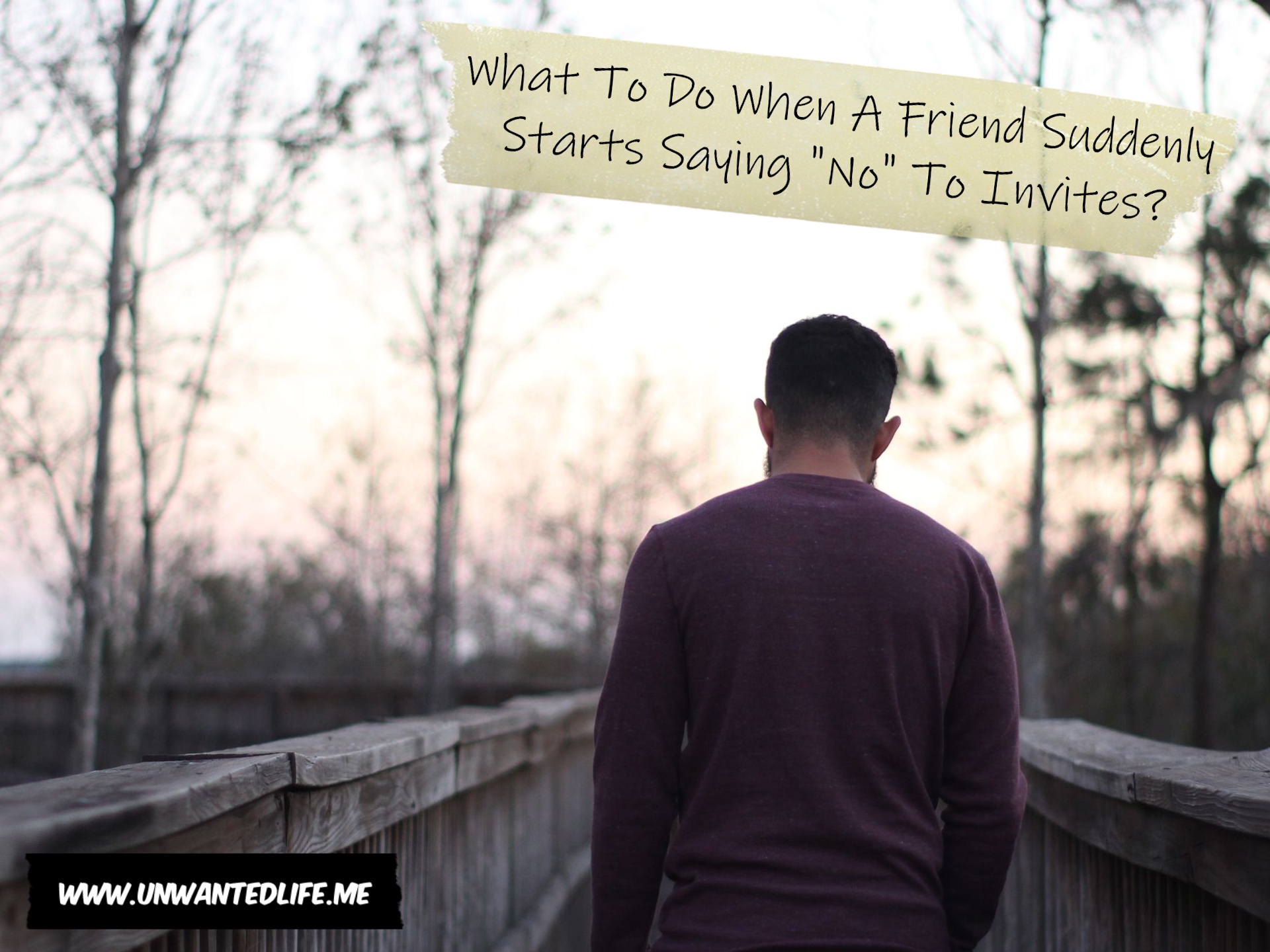
When friends and other people from our social support network start saying “no” to invites, it can be difficult for us to know how to process that. Too often, we often come to the wrong conclusion when this happens. This is what I want to explore in today’s article, as I’ve been that person whose pulled away.
When A Friend Starts Saying “No” To Invites
As life changes, we often find ourselves in situations where our friends who usually love hanging out with us and doing stuff with us may suddenly start saying “no” to invites. Almost without fail, most of us may feel like it’s something we’ve done, and start feeling pretty shitty about ourselves. Self-doubt is such a pain sometimes. So before we start assuming the other person doesn’t want to be our friend. Consider this article.
No one likes that sense of rejection, but is the rejection we’re feeling real? That’s the question.
The instinct to assume we’ve done something wrong can be quite powerful. But there are a million and one reasons why it isn’t because of us. The most common issue is something like a change of circumstances, like entering a new relationship, having children, changing jobs, or moving away.
But the main one I want to discuss today is the one that often gets forgotten about, and that’s the change to our friend’s internal world. When our mental wellbeing is struggling, we have a tendency to pull away from those around us, the very people who may be able to help us manage that struggle. Thus, we start saying “no” to invites.
It’s one of the most annoying paradoxical habits we humans have.
What To Do When A Friend Starts Saying “No” To Invites
Uncover the root cause
Before we start blaming ourselves, it helps to understand why someone might suddenly pull away and start saying “no” to invites. In today’s world, where we barely have time to look after our own mental wellbeing, our friends’ mental wellbeing and feelings of being overwhelmed are things to consider.
Even without conditions like depression or social anxiety, which often cause us to retreat and start saying “no” to invites, general stress and a lowering of our mental wellbeing can be enough to cause us to socially isolate ourselves.
Social interaction requires energy/spoons, and when someone is burnt out, saying “no” to invites becomes a self-preservation mechanism. There are also changes to people’s health that might need to be considered, as many health conditions, chronic illnesses, and disabilities can greatly affect our energy levels.
As previously mentioned, there are also things like major life transitions and life stressors. It’s also all too easy to experience financial stress at the moment, as the cost of living crisis bites hard; as such, our friends may not feel able to share that they can’t afford to do the suggested activities.
Then there’s the high-pressure workload that often comes with organisations expecting us to do the work of multiple people so they can save money on staff. There are also things like family crises, becoming a parent, etc.
Prioritisation shifts could also be a factor, where hanging out with us has moved down the priority list. Most often, this is a result of starting a new relationship or starting a family, but can also be because they’re chasing a new personal goal.
Less common is relational friction. It’s rare for something like this to suddenly happen overnight, but there is a chance an unaddressed misunderstanding or conflict has made them pull away. Thus, they start saying “no” to invites.
Choosing the right approach
- The supportive check-in: If we suspect burnout, stress, or mental health issues are involved, then a check-in can be an easy and effective approach. Saying something like, “I’ve noticed you’ve been turning down plans lately, and no pressure at all, but I just wanted to check in. How are you holding up?” via a message can show we’re there for them, but also makes it easier for them to reply.
It might also be useful to try the ask-twice approach, as people have a tendency to comply with social expectations when asked this kind of question, which is to just say “I’m fine”.
- Lower the barrier to entry: Pivot to low-stakes hangouts. If we’re only suggesting high-energy activities like parties, concerts, hiking, etc., then switching to something simple like meeting for coffee might get the other person to accept.
Same with high-cost activities; maybe suggesting hanging out at our home will mean they’ll be more likely to say “yes”, or even just switching to a video hangout to close the distance or lack of free time gap.
- Match their energy: If our friend seems fine elsewhere, but distant with us specifically, then maybe we need to take a step back. Take a break from initiating for a short period, and give them the space to reach out on their own terms.
- Direct but gentle addressing: If there is no clear reason for them withdrawing from us and not accepting our invites to hang out, then it can be worth considering engaging in conversation. I know this can be hard for a lot of people, but sometimes we just need to talk things out.
We can start by simply expressing that we miss hanging out with the other person. Then follow up with asking, “Is everything ok between us, or do you just need some space right now?”
Manage our boundaries
Every relationship with anyone can benefit from boundaries. I know it can be difficult to not take it personally when the people we care about aren’t accepting our invites, but try to remind ourselves that people rarely withdraw out of malice; they usually do it out of exhaustion.
There are also many factors that have nothing to do with us that come into play. I lost a lot of my close friends when I moved away, because it became very difficult to maintain the friendship with that distance existing.
It’s also important to not hold open prime weekend and evening slots for someone who consistently turns us down or cancels plans. Even good friends can be flaky. Keep living our life and making alternative arrangements where we can, or learn to fit them around our reliable friends when it comes to making plans.
This means we’re leaving the door open for them, and if they have confirmed they just need space, we can let them know we’ll be there when they’re ready to start hanging out again.
What Not To Do When A Friend Starts Saying “No” To Invites
Assume they want space
When our friends are pulling away for reasons others don’t know, like poor mental health, us stopping inviting them altogether without any context can feed the reason why they pulled away. The concern that they’ll just continue saying “no” to invites can be a powerful force in making assumptions like this.
It’s so easy for the negative intrusive thoughts to convince us that no one likes us or that we’re a burden to our loved ones the worse our mental health gets. So don’t stop inviting them to things completely, and ideally, try reaching out to them.
When my health started to decline, and I was still struggling with psychosis and two anxiety disorders, I was saying “no” to invites a lot, or cancelling. It was just too much to juggle at once in a lot of the social situations I was being invited to. I wanted to go, but I just couldn’t. Now I’m more able to say “yes” because I have everything better under control.
Keeping spamming them with invites
On the flip side, it can also cause people to feel a lot of pressure if we keep bombarding the person who’s saying “no” to invites with more invites because they’ll feel bad for declining.
Again, reducing the frequency of the invites and mixing up the kind of invites we make can be useful. But never underestimate the power of reaching out and checking in.
Summary
When it feels like a friend is distancing themselves by saying “no” to invites, there may be more at play than meets the eye. It’s easy to default to thinking they don’t like us anymore, but that is rarely the case.
There are many, many reasons why someone might decline our invites, and most of them have little to do with us. Health issues, work, stress, romantic relationship changes and difficulties, or worsening mental wellbeing are often the most common reasons.
I know it’s easier said than done, but we need to try not to take it personally and instead think of the other possible reasons. And with any relationship, good old communication can often be the one thing that’s needed.
As always, leave your feedback in the comments section below. Also, please share your experiences with friends saying “no” to invites in the comments section below. Don’t forget, if you want to stay up-to-date with my blog, you can sign up for my newsletter below. Alternatively, click the red bell icon in the bottom right corner to get push notifications for new articles.
Lastly, if you’d like to support my blog, please find the PayPal and Ko-fi donation payment options below. Until next time, Unwanted Life readers.
When I was in my 20s, I used to be the event organizer among my buddies. I was always the one who send invites to our hangouts. It kinda upset me when people said no. Now, I no longer no longer bother to invite my friends to join my hangout. Who ever wants join, just join. They are welcome. And whoever is not interested to join, it’s ok.
Being the event organiser in a group is a lot of work