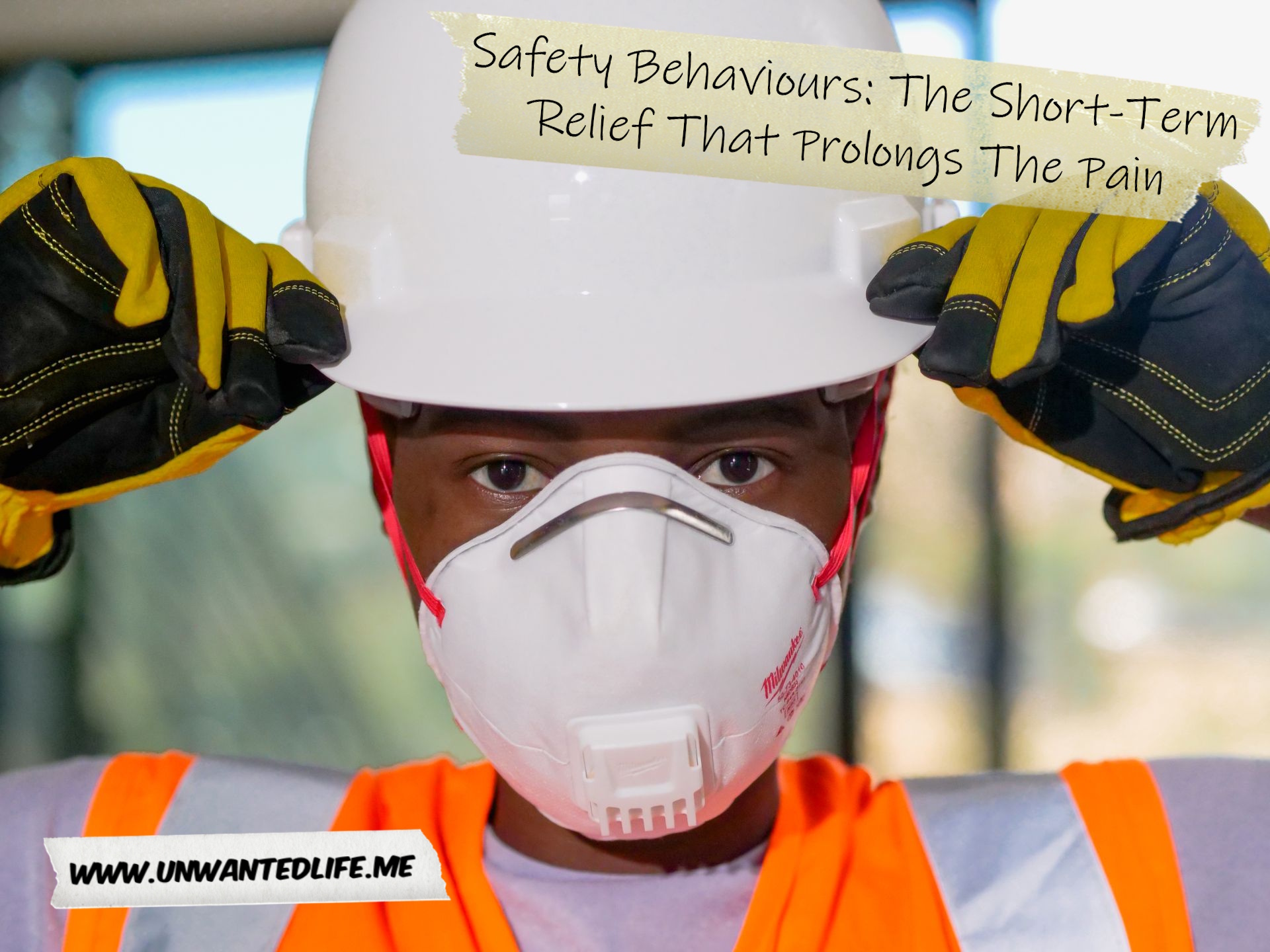
Safety behaviours in the workplace are a great thing to have, that’s why we have fire safety drills and the like. However, when it comes to our mental wellbeing they are very much part of the problem. In this article I’ll explain why, and how to dismantle such safety behaviours.
What Are Safety Behaviours
In the context of psychology and mental health, safety behaviours are coping strategies used to “survive” a perceived threat. This sounds like a good thing on paper, but the relationship between safety behaviours and mental health is paradoxical.
Safety behaviours feel helpful in the moment, but they actually maintain the cycle of anxiety. This is also how they differ from healthy preparation and adaptive coping strategies (Thwaites and Freeston, 2005), because their primary goal is to prevent a feared outcome that is usually unlikely to happen.
This is what makes safety behaviours a double-edged sword. They start off feeling helpful because they are. They help manage the anxiety and discomfort that’s right before us, but that’s also part of the problem. Because in the long-term, that short-term relief in the form of safety behaviours is detrimental to our recovery.
According to Goodson, Patel, Zech, Sala, and Cougle (2026), safety behaviours are actions or strategies we adopt to manage anxiety or distress, such as phobias, social anxiety disorder, health anxiety, and post-traumatic stress disorder (PTSD). The immediate relief they can provide is addictive, and it’s the easiest way to manage the discomfort we’re trying to manage or avoid. I know, I’ve been there.
But each use of our safety behaviours reinforces the very anxieties they’re meant to mitigate. By sticking with our safety behaviours, we’re not allowing ourselves the opportunity to challenge the very thing that’s causing us to use these safety behaviours (Evans, Chiu, Clark, Waite, and Leigh, 2021).
Like a lot of fear that we can develop, taking the shape of one of the many anxiety disorders, many of them aren’t realistic or are extremely unlikely. But the use of safety behaviours will power up that fear so it never goes away.
Anxiety disorders and safety behaviours work together like a hand in a glove (Meyer, Kirk, Arch, Kelly, and Deacon, 2019). Think of it like throwing fuel on a fire rather than sand or water. In some situations, as I said, there may be a legitimate reason for our safety behaviours, ones that don’t feed the fear. That’s when they become adaptive coping strategies (Thwaites and Freeston, 2005).
Furthermore, figuring out the difference between a safety behaviour and an adaptive coping strategy (Thwaites and Freeston, 2005) is difficult at the best of times, but this is made worse when a chronic health problem is thrown into the mix (Sharpe et al., 2022).
Common Safety Behaviours
Rehearsing
Someone with social anxiety or phone anxiety may find themselves rehearsing sentences before speaking. They may even write out a little script when they have to make a phone call. I know I did.
Body language
Another socially relevant safety behaviour is avoiding eye contact. Again, something common with those of us with social anxiety.
Checking behaviours
The one we’re most familiar with is how people with obsessive-compulsive disorder (OCD) engage in constant checking. But it can be the same with people who have healthy anxiety, who may have to keep checking their symptoms using AI or googling. They could also feel the need to regularly check things like their pulse. Repeated body checking was one of my safety behaviours, to see if I was wet.
Carrying unneeded items
Depending on how their anxiety affects a person, it could range from carrying a change of underwear to carrying medication. Just in case.
Exists
Another common safety behaviour is to stay close to the exists. Or at least knowing where they all are. For me, it helped to know where the toilets were.
Communication
It’s common to either not talk about ourselves, censor what we say, or to just be very quiet in any social situation. This is done to avoid the possibility of embarrassing ourselves or somehow causing someone to judge us in a negative way (Evans, Chiu, Clark, Waite, and Leigh, 2021).
The False Credit Problem
The reason why safety behaviours can be so effective in reinforcing our fears is that we misattribute our success in not having an anxiety or panic episode to the safety behaviours. In season seven, episode 23 of The Simpsons, Lisa and Homer encapsulate this quite well when talking about the Bear Patrol and how a rock can keep tigers away.
When we credit the wrong thing, it prevents our brain from learning that the situation is inherently safe (Sharpe et al., 2022). Therefore, it keeps us trapped in a loop of needing these safety behaviours to function. We may feel like we’ve avoided or escaped the situation, but then we’re left with the belief that we only survived because of this safety behaviour, rather than through our own ability.
Using safety behaviours is exhausting. They rob us of our quality of life, and they stop us from learning that we can tolerate that which causes us fear, meaning we can’t grow.
The amount of time and energy I wasted on self-monitoring, let alone the stress all this caused, is staggering. I was just so desperate to avoid my worst fear happening, even though it had never happened in the first place. The latter is often the case for most people who use safety behaviours (Thwaites and Freeston, 2005).
Safety Behaviours And Their Costs
There are many flavours of safety behaviours, some of which can be very subtle. The following is a breakdown of some of the safety behaviours we might find ourselves engaging in.
Avoidance
Avoidance is the top dog of safety behaviours; it’s also the strongest factor in maintaining the fear underpinning our anxiety (Sharpe et al., 2022). Avoidance can take several forms, and not all of them will be overt, so we might not even realise we’re engaging in avoidance.
But one thing that doesn’t change is how it’s reflected in our self-reported anxiety and sense of authenticity (Evans, Chiu, Clark, Waite, and Leigh, 2021).
Escape
A common thing people experience is the desire to leave a situation once anxiety starts to escalate. It makes sense. When we feel our anxiety levels rising, leaving the situation seems like the best thing to do.
But when we do it all the time, we never give ourselves a chance to confront it and stay in the discomfort. Before long, instead of escaping, we’ll just start avoiding the situations that trigger us altogether.
Neutralisation
This is often pitched as a coping strategy, and for some it may be just that. But for others, it can just become another safety behaviour. That’s because engaging in some form of distraction, a ritual, or routines to counteract anxiety doesn’t help us overcome the anxiety.
Seeking reassurance
When I had my first full-on psychotic break, I sought reassurance from others because I no longer trusted my perspective on reality. But it can also manifest in other ways, such as checking in on our partners or constantly asking if you’re doing a good enough job at something.
Maintain negative thoughts
By avoiding our triggers, we never get to challenge our fears and learn to cope with them in a healthy way. This reinforces the belief that the threats are real and dangerous, which makes those unwanted intrusive thoughts so much stronger.
Limit life experiences
There’s nothing more limiting to our quality of life than the obstacles we put in our own way, and our use of safety behaviours is one of those obstacles. Avoidance restricts our life and prevents us from engaging in activities we enjoy or need to do.
This can lead to isolation and decreased independence. As such, we might not try anything new because we don’t want to be seen as rubbish or may be too scared to socialise with people we don’t know who’ll be there.
Increase anxiety in the long run
As previously stated several times, safety behaviours are fuel for our anxiety fire. Over-reliance on safety behaviours just makes us more sensitive to anxiety in the future. Every time we avoid a trigger, we expand our catalogue of examples that confirm our anxiety. This then leads to heightened anxiety in similar situations. This stops us from learning that the feared outcome is unlikely or manageable.
Delay recovery
Safety behaviours will distract us from addressing the underlying anxiety belief, and thus will delay true recovery. They’re just a way of masking the problem instead of solving it. Even well-meaning advice can become part of the problem.
It’s important to be aware that some treatment suggestions can help us with getting a better grasp of our fears, but they too can turn into safety behaviours if we don’t also work to reduce our reliance on them. This can make things like breathing exercises both helpful, but also a problem if left in place (Thwaites and Freeston, 2005).
Dependency
Relying on safety behaviours may (almost always will) create a dependency on them to cope with anxiety. It doesn’t take much for us to feel like we’re unable to manage anxiety without these safety behaviours, leading to increased anxiety when they’re unavailable.
Interfering with learning
Life is really a series of lessons, and safety behaviours prevent us from learning the correct lesson. That we can manage anxiety-provoking situations without these actions. This hinders the development of more adaptive coping skills, eroding our mental wellbeing and quality of life as a result. Of course, this also means we’ll avoid other situations where personal growth or achievement is possible.
Managing And Overcoming Our Reliance On Safety Behaviours
As someone who has a fondness for cognitive behavioural approaches like exposure therapy, reducing and ideally eliminating safety behaviours is very important (Sharpe et al., 2022). Therefore, factoring in a systematic approach to reducing and eliminating safety behaviours during treatment for all anxiety disorders is important, because it enhances outcomes (Goodson, Patel, Zech, Sala, and Cougle, 2026).
Identification
A good place to start is figuring out what our safety behaviours are. This makes for a good journaling task, and only requires us to notice the subtle habits used to feel “ok” in stressful environments. If we identify our trigger while doing this as well, all the better.
Experimentation
This is a simplified approach to exposure therapy, where we can slowly enter a situation while intentionally dropping one specific safety behaviour, or at least prolonging the time before we fall back on it.
When doing this experiment, observe whether the feared catastrophe occurred or not. By removing these barriers, the mind finally receives the evidence it needs to build resilience, confidence, and start growing a book of evidence that what we feared doesn’t deserve our time and energy.
Changing view on safety behaviours
A strategy suggested by Meyer, Kirk, Arch, Kelly, and Deacon (2019) as a result of their study, is to make sure we explore and challenge the beliefs around safety behaviours. They feel safe for a reason, and we use them because we feel they work. So it makes sense that any strategy to stop using them would benefit from challenging the belief in their effectiveness and usefulness.
Exposure therapy
In the Thwaites and Freeston (2005) paper, they discussed a clinical client who was scared they’d have a heart attack. For 13 years they wouldn’t go anywhere without a trusted adult. They’d never had an issue with their heart, yet this fear existed. Having that trusted person with them whenever they went meant they credited the trusted friend being there as working, when really it wasn’t.
I’ve been in that near-exact situation myself, where I struggled to leave my comfort area without having someone with me, which was often my partner. They took time off to go to my many hospital appointments because of this issue. But then I decided to stop letting my fear control me, and I stopped engaging in my safety behaviours.
It wasn’t easy in the beginning. Ignoring our safety behaviours is very hard, because we have nothing but the discomfort and fear pumping through our veins. But the benefits of doing so were massive for me. I pretty much stopped having psychotic episodes, as mine were triggered by my anxiety. Going from daily episodes to years without one was huge. And this was because I took on an exposure therapy mindset.
Furthermore, according to Evans, Chiu, Clark, Waite, and Leigh (2021), people rate our conversational quality as less likeable when we’re avoiding participating freely in the conversation. That fear of being judged negatively or want to avoid embarrassing ourselves, ends backfiring.
This means that being an active participant in social interactions, rather than being silent, will be better at getting the positive impression we’re hoping for, and means we don’t have to live our lives inauthentically. In short. Ditch the mask.
Creating an exposure plan is fairly simple; we start with a fear hierarchy, creating a list from the least triggering situation to the most triggering situation. Then, working from the least triggering situation, we create a plan to overcome it.
An easy example is a fear of spiders. We may start with looking at a simple drawing of a spider, moving on to a detailed drawing, then maybe a photo, then a video; you get the idea. We move up the fear hierarchy once we’ve become comfortable with the current step we’re on.
Pointing and saying
There’s a useful checking method from Japan, called Shisa Kanko, which can help restore our trust in our own memory. So if we do a lot of checking, like checking the cooker is off several times, then doing this once, pointing at the cooker, and saying the cooker is off, can help us stop that checking behaviour.
Once we have trust in our memory again, we can then try to cut down on this approach so it doesn’t become just another safety behaviour.
Cognitive reappraisal
It can be useful to reevaluate our past experiences that help support our fear, to see how true that it is. My anxiety and psychosis had me so convinced that I’d pee myself or lose bowel control in public that I didn’t stop to think that I had got through thousands of examples where that never happened, but it had never happened to me in the first place.
This also helps to place the success in getting through those situations in the right place. This is why I added a cognitive reappraisal to the start of my second edition exposure workbook.
Identify triggers
As stated further up in this list, identifying our triggers can be useful. Once we start paying attention, we can become aware of the situations, thoughts, or feelings that trigger our anxiety, and what triggers our use of safety behaviours we use to cope. We can then take steps to better manage our anxiety and our response to our anxiety.
Challenge negative thoughts
A reliable strategy to overcome our safety behaviours is to challenge the thoughts that either trigger the safety behaviours or are a general response to the thing we’re trying to avoid.
There’s two solid thought challenges for this. There’s putting the thoughts of trial, where we weight the objective evidence for and against the unwanted intrusive thoughts, and there’s reframing. Reframing is where we look for a neutral or positive alternative to the thoughts.
Accepting our thoughts
This is also a form of exposure therapy, because sometimes challenging our thoughts can make the unwanted intrusive thoughts stronger. If that happens, accepting the thoughts for what they are, and that they don’t have power over us unless we give it too them, is another way to go.
We sit with the thoughts and let them run there cause, accepting them for what they are. Just thoughts. And that we’re more than the sum of our thoughts.
Seek professional help
If none of the above works, or we just need a little extra support to get through it all, then consider seeking help from a therapist. They can provide guidance and support in developing healthy coping strategies, replacing the safety behaviours. They can also help with us overcoming the anxiety and fear that under pins it all.
Cognitive behavioural therapy (CBT) is a good form of therapy for this, as is exposure therapy. These approaches can help us with addressing and gradually reducing reliance on safety behaviours, which is a key component of treatment for anxiety disorders.
Summary
Safety behaviours are the behaviours we develop that we think helps us with our anxiety and fears, and that’s partly true. They can help with the short-term discomfort these cause. However, they also reinforce the anxiety and fears each time we use them, making our long term recovery much harder.
One of the best approaches to tackle these kinds of issues is to focus on the safety behaviours, as they are whats maintaining the anxiety and fear in the first place.
Remember, overcoming safety behaviours is going to take time and effort. How much time and effort will vary person to person, so be patient, and celebrate any and all progress. Self-help options, like those listed in the article are a good starting point, but they don’t have to be the only option, so don’t hesitate to seek help when needed.
As always, leave your feedback in the comments section below. Also, please share your experiences with safety behaviours in the comments section below. Don’t forget, if you want to stay up-to-date with my blog, you can sign up for my newsletter below. Alternatively, click the red bell icon in the bottom right corner to get push notifications for new articles.
Lastly, if you’d like to support my blog, please find the PayPal and Ko-fi donation payment options below. Until next time, Unwanted Life readers.
References
Evans, R., Chiu, K., Clark, D. M., Waite, P., & Leigh, E. (2021). Safety behaviours in social anxiety: An examination across adolescence. Behaviour Research and Therapy, 144, 103931. Retrieved from https://pmc.ncbi.nlm.nih.gov/articles/PMC7611485/pdf/EMS131720.pdf.
Goodson, J. T., Patel, T. A., Zech, J. M., Sala, M. C., & Cougle, J. R. (2026). The standalone effect of safety behavior manipulations: A systematic review and meta-analysis. Clinical Psychology Review, 102703. Retrieved from https://pmc.ncbi.nlm.nih.gov/articles/PMC12997458/pdf/nihms-2149736.pdf.
Meyer, J. M., Kirk, A., Arch, J. J., Kelly, P. J., & Deacon, B. J. (2019). Beliefs about safety behaviours in the prediction of safety behaviour use. Behavioural and Cognitive Psychotherapy, 47(6), 631-644. Retrieved from https://figshare.com/articles/journal_contribution/Beliefs_about_safety_behaviours_in_the_prediction_of_safety_behaviour_use/27746520?file=50505618.
Sharpe, L., Todd, J., Scott, A., Gatzounis, R., Menzies, R. E., & Meulders, A. (2022). Safety behaviours or safety precautions? The role of subtle avoidance in anxiety disorders in the context of chronic physical illness. Clinical Psychology Review, 92, 102126. Retrieved from https://doi.org/10.1016/j.cpr.2022.102126.
Thwaites, R., & Freeston, M. H. (2005). Safety-seeking behaviours: fact or function? How can we clinically differentiate between safety behaviours and adaptive coping strategies across anxiety disorders?. Behavioural and Cognitive Psychotherapy, 33(2), 177-188. Retrieved from https://www.researchgate.net/profile/Richard-Thwaites-3/publication/231971376_Safety-Seeking_Behaviours_Fact_or_Function_How_Can_We_Clinically_Differentiate_Between_Safety_Behaviours_and_Adaptive_Coping_Strategies_Across_Anxiety_Disorders/links/0a85e52fa821591dd0000000/Safety-Seeking-Behaviours-Fact-or-Function-How-Can-We-Clinically-Differentiate-Between-Safety-Behaviours-and-Adaptive-Coping-Strategies-Across-Anxiety-Disorders.pdf.
My fears make me create two personas. When I’m with my people, I’m all myself. But when I’m stuck with those who have overwhelming energy, I’m a cynical person 😛 The cynical persona is to tell those overwhelming people that I don’t like them. So stay away from me. But recently, I realised that creating a cynical persona doesn’t help me heal. It only builds a wall. Right now, I’m trying my best to heal myself.
Does that version of yourself actually tell those people to go away or is this more an internal dialogue?
Unwanted, I sincerely appreciate your blog. Just wanted to let you know why I recently took you out of the notification loop. My email inbox fills up with nearly 1,000 notices every day, so I have to limit it to notifications from those who visit regularly. Good to see you back again, and thank you for being understanding!
Nothing you need to apologise for or explain