It’s coming up to Halloween, so I wanted to take a more Halloween-y approach to a few of my articles this October where possible (I know, it’s still September by a day, but who’s counting) because this is the best time of year. I was also listening to the Eminem ft. Rihanna song, ‘The Monster’, while thinking about what my next article could be on, and the two fit perfectly. I hope you find it a useful and enjoyable article.
What Is The Monster Inside My Head?
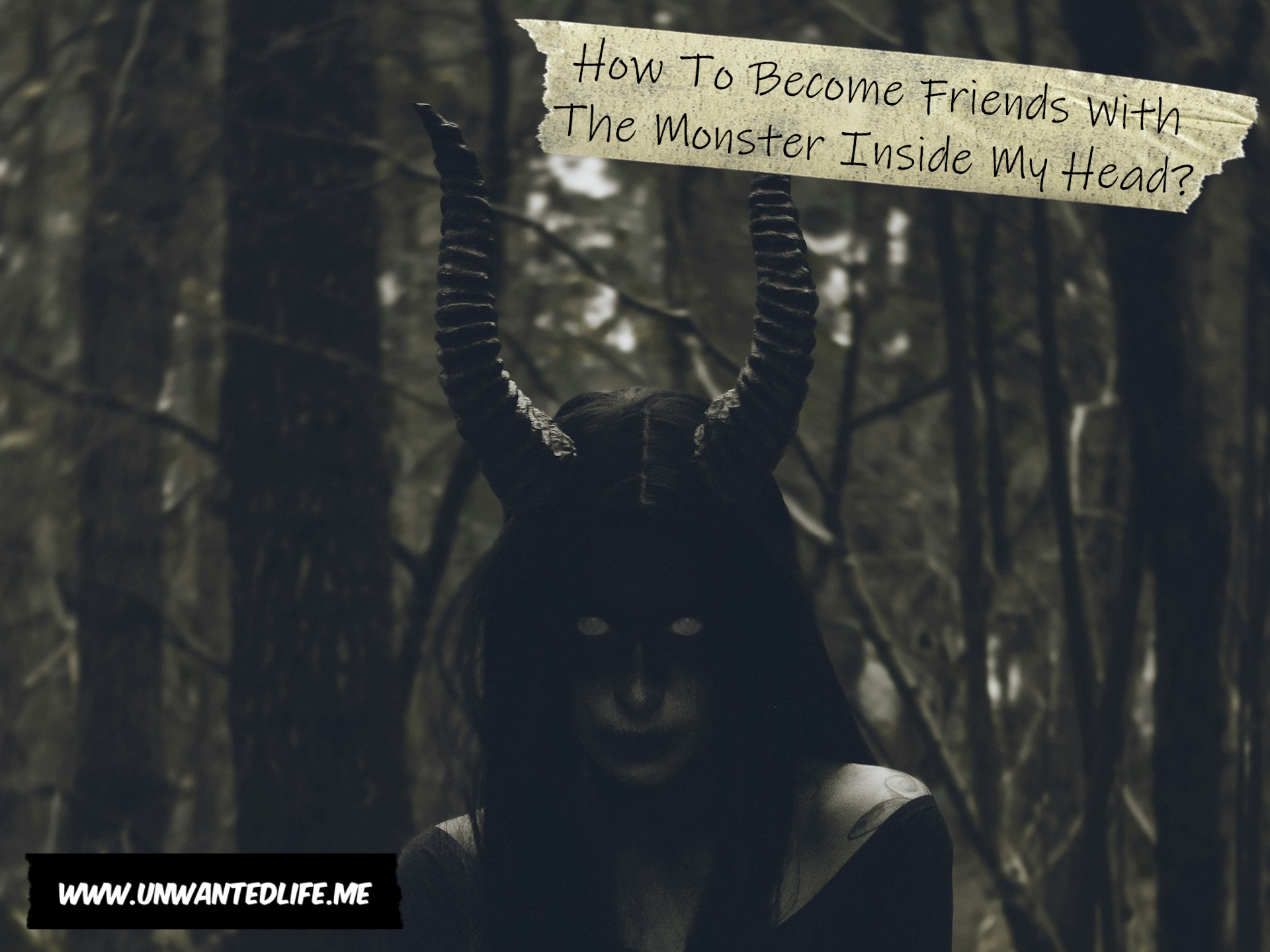
“The monster inside my head” is a fairly common metaphor for mental health struggles, intrusive thoughts, anxiety, or obsessive-compulsive disorder (OCD). For a lot of us, it’s common to experience an inner voice that can be very critical of us in a way we would never speak about others (Dave, 2026).
It can help to think of that inner voice, that monster, as an algorithm created by our brain in response to an event (trauma, abuse, bullying, etc.) or our environment, where we may have felt we had little control or agency (Blanch, 2021). For example, when we relied on support or external validation and approval.
This may have worked to protect us at the time, but it quickly becomes an algorithm stuck in a time we don’t need protecting from anymore.
Thus, this protective inner voice becomes a harsh inner critic that feels like a monster in our heads. This often means we’re left with a relentless inner critic that is trying to anticipate a treat or prevent harm that’s no longer coming (Dave, 2026).
The monster in our head doesn’t mean to be our enemy, it just hasn’t understood that things have moved on from the time our brains created it to protect us (Blanch, 2021). Thus, we need to make our monster aware that things have changed, rather than unintentionally reinforcing it with our safety behaviours.
Befriending The Monster
The monster in our head can show itself in many forms. It can be a fierce inner critic, an anxious spiral, or a shadow self. But befriending the inner monster isn’t about defeating it in some kind of epic showdown.
More often, it’s about realising that the monster is actually just a terribly misguided defence mechanism wearing a scary mask. When we stop trying to banish it to the shadow realm, we change the dynamic entirely.
When we talk about the monster, we are usually talking about a fragmented part of ourselves, which from a Jungian perspective would be called the ‘shadow’, or what modern therapies like internal family systems (IFS) call ‘protectors’.
Monsters aren’t born; circumstance creates them. At some point in our life, usually our childhood or a period of high stress, we experienced some form of emotional pain, rejection, or failure. To ensure we never felt that way again, our brain created a defence mechanism.
But this defence mechanism grew to be our monster. The monster can be fed by events that confirm its birth, even if we’re misinterpreting these events, which is often the case due to our negativity bias. This can be further made worse by the cognitive biases we can develop, especially if our core beliefs become unhealthy.
The tragedy of the inner monster is that it’s using terrible, destructive methods to achieve a benevolent goal: keeping us safe. It acts like a monster because it is terrified. After all, we were fearful at the time it was born.
But when the monster feels heard and safe, its defensive posture relaxes, and it stops using its claws and starts using its focus.
The Metamorphosis: Transforming The Monster
One of the big things in science is that we can’t destroy energy; we can only change its state. With the monster, we can’t destroy it; we can only transform it. When we successfully befriend our inner monster, it doesn’t disappear from our head entirely.
For some, it may fade into the background and only come back if something triggers it, but we can also get the monster to take on a new job description.
The monster’s old job: The perfectionist
The perfectionist monster typically starts as a form of protection (Kang, 2025), one that traps us. How that manifests can vary, but it’s common to avoid doing anything we don’t think we’ll instantly be good at or won’t do in case people see we’re not perfect. We also won’t accept anything better than perfection in the things we do.
But that’s a very draining and unhappy life to live, so we want to move our monster from being our perfectionist to shaking off the fear of failure and focusing on high standards (not perfection), where we hopefully end up with craftsmanship and dedication. At the same time, our standards don’t even need to be that high; we can move to good enough, being good enough, because in almost everything we do, it is.
The monster’s old job: Raging protector
The protector functions like a faulty smoke alarm. It calculates every worst-case scenario because it genuinely believes that if it worries enough, we won’t be caught off guard. But we want to move the monster from being our raging protector to helping it stop lashing out internally and start enforcing healthy boundaries. Thus taking on the job of being a self-protection and assertiveness advocate.
The monster’s old job: Hyper critic
Such a monster usually starts as an attempt to criticise us before anyone else can. If it beats us up first, it thinks it is keeping us safe from the devastating surprise of external rejection. Either way, we’re still getting a beating.
What we want is to move the monster from being our hyper inner critic to helping it stop panicking and become a sharp, analytical problem-solver, thus becoming our strategist.
How To Befriend The Monster
Integrate the monster (shadow)
In psychological concepts, the parts of ourselves we reject or deem “monstrous” don’t disappear; they just ferment in the basement. True integration means recognising that this part of us often holds misdirected energy.
For example. A perfectionist monster might just be a passionate creator who is terrified of not being good enough; an angry monster might be an overly fierce protector of our personal boundaries. Once it feels safe and heard, that raw energy can often be redirected into something constructive.
Forget avoidance and suppression
Avoiding and suppressing the voice of the monster inside our head often has the exact opposite effect (Seif and Winston, 2018). The monster wants to be heard because it thinks it’s helping us. What often happens when we ignore a child, they will do things to get our attention, even if it means throwing a tantrum. That’s basically how our monster works as well.
We may be able to distract ourselves from it for a while (Blanch, 2021), but the thoughts we’re trying to avoid will come back again, sometimes when we’re not prepared to handle it.
Accept the monster
First, it helps to look at why the monster exists inside our head and how we can practically renegotiate our relationship with it. According to Schwartz (2013), IFS therapist found that the biggest roadblock to change is a lack of self-acceptance. Thus, being able to accept the monster in our head can help with changing the role of the monster or getting it to hibernate.
The goal isn’t to silence the monster from being our harsh inner critic but to change how we relate to it (Dave, 2026). Often fighting with this monster just feeds it like throwing fuel on a fire, but if we accept what it’s saying rather than challenging it, the monster feels heard and will stop pestering us. It also helps with gaining insight about the monster and why it’s here in the first place.
Pull back the curtain (personification)
Monsters thrive on ambiguity and darkness. When it speaks in vague, overwhelming absolutes like, “You’ll mess this up” and “Nobody likes you”, force it to get specific. Giving the voice an identity, a visual form and a name, can help break the monsters power over us. This is called personification (Gershman, 2020).
It’s much easier to negotiate with a dramatic, stressed-out monster named Barry III than an existential, nameless inner voice.
Establish a dialogue with our monster
Befriending our monster doesn’t mean liking what it says. That’s not what acceptance is. It just means changing how we respond to it. To break the loop where we mistakenly feed the monster and make it stronger, we can use a technique called ‘externalised dialogue’. When the monster starts talking to us, grab a pen and paper and write out the conversation.
- The monster: “You’re going to mess this up. Why do you even bother?”.
- Us (the host): “I hear you. You’re really loud right now. What are you worried will happen if I mess up?”.
- The monster: “People will see you fail and they’ll think you’re a fraud”.
By writing out the interaction like a dialogue, we slow our thoughts down to a more manageable pace. This can help reduce the feeling of being overwhelmed by it. So let it speak without immediately fighting it or agreeing with it so we can uncover the core vulnerability.
It’s a bit like using downward arrowing to find an unhealthy core belief, just through the use of dialogue used to move the conversation from “You’re a failure” to “Ah, you’re terrified of being rejected”. At least in this example.
This is important because the relationship with have with ourselves is arguably the most important relationship we have in our lives (Dave, 2026). That means we benefit from finding a way to accept, live, and adapt the monster in our head so we can improve our quality of life.

Shift to curiosity
Much like establishing a dialogue by writing it out, we can also engage with it using our inner voice. So when the monster flares up, try to avoid the instinct is to fight back or suppress it.
Instead, we should try treating it like a hyper-vigilant, completely exhausted monster working as our security guard who has been awake for three days straight. As such, shift our internal dialogue from adversarial to curious.
- Adversarial: “Shut up, you’re ruining my day and making me miserable”.
- Curious: “I hear you sounding the alarm loudly right now. What exactly are you trying to protect me from?”.
This is important because studies have shown that self-curiosity supports emotional regulation and reduces cognitive rigidity (Kang, 2025). Furthermore, behind almost every harsh inner critic is a core fear of vulnerability, rejection, or failure. When we address the underlying fear we can work to deflate the monster or assign it a healthier role.
Put the monster in the passenger seat
It’s also important to remember that when we befriend the monster, that doesn’t mean giving it free reign. We can validate its existence without letting it be in control. Acknowledge its presence, thank it for its highly enthusiastic (if unhelpful) input, but maintain our boundary.
We acknowledge what it’s said, but at the same time we’re telling it we’re going to take the lead on this one. This is a form of cognitive reframing (Kang, 2025). The monster only wants to be heard, after all.
What birthed the monster
Generally, some event, series of events, or trauma is the reason our monster was born. Shifting to curiosity and establishing a dialogue with our monster are two good ways to get to the why the monster is here. However, finding out why it’s trying to protect us doesn’t always mean we know the events that lead to its creation. But sometimes it can.
For the times it doesn’t, it can help to explore our life events as a journaling exercise, and reappraise some of the events with our current understandings.
A lot of the stuff that can happen to us growing up doesn’t always register as being harmful. But as we explore the world and get exposure to healthier relationships, that insight can come. This is what can make it a good journaling exercise.
Take the monster to therapy
When it comes to things like trauma, we can often benefit from professional support (Blanch, 2021), and there’s nothing wrong with that. But even if it’s not trauma related, incorporating our monster into something more helpful can also benefit from the aid of a therapist.
Working with a therapist that won’t judge us and who will provide compassion can really help with learning about the deep dark recess of our mind, the parts where our fears hide (Schwartz, 2013). Then help us work out a plan to better manage those parts of us.
Summary
When it comes to the monster in our head, it’s not a one-time fix. It often takes practice. The monster has likely been running the security department of our brain for years, so it won’t trust our leadership immediately.
It will test us by getting loud again. This makes the first stage of changing our monster the hardest part, but one worth sticking too. By starting with the goal to simply notice it, name it, and refuse to view it as an enemy, we’ve taken the first important step.
Remember, it is a part of us, but a part that got stuck in the dark, and it needs us to show it the way out.
As always, leave your feedback in the comments section below. Also, please share your experiences with the monster in your head in the comments section below. Don’t forget, if you want to stay up-to-date with my blog, you can sign up for my newsletter below. Alternatively, click the red bell icon in the bottom right corner to get push notifications for new articles.
Lastly, if you’d like to support my blog, please find the PayPal and Ko-fi donation payment options below. Until next time, Unwanted Life readers.
References
Blanch, A. (2021, May 10). The enemy within – healing the critical voice. Good Psychology. Retrieved from https://www.good-psychology.com/post/the-enemy-within-healing-the-critical-voice.
Dave, H. (2026, May 30). Why are Our Inner Voices so Mean and Critical?. Hennessy Clinical Psychology. Retrieved from https://hennessyclinicalpsychology.com/why-our-inner-voice-is-so-mean.
Gershman, N. (2020). I Am the Very Worst Person on Earth and Other Myths: Understanding and Reconciling With the Inner Critic. Pacifica Graduate Institute. Retrieved from https://delos-inc.com/articles-b/THESIS%20N.%20Gershman%203_5.pdf.
Kang, M. (2025, November 2). How Internal Family Systems can help you befriend your inner critic. Psychology Today. https://www.psychologytoday.com/gb/blog/rebuild-your-life/202511/the-well-meaning-protector-befriending-the-inner-critic.
Schwartz, R. C. (2013). Moving from acceptance toward transformation with internal family systems therapy (IFS). Journal of Clinical Psychology, 69(8), 805-816. Retrieved from https://sppc.org.pt/downloads/IFSTherapy/RS_schwartz_moving_from_acceptance.pdf.
Seif, M., & Winston, S. (2018, April 26). Unwanted Intrusive Thoughts. Anxiety and Depression Association of America. Retrieved from https://adaa.org/learn-from-us/from-the-experts/blog-posts/consumer/unwanted-intrusive-thoughts.
My inner demon is my inner child. She is childish and quite impulsive. Every time she strikes, my higher will be kind and comfort her. But there are times where my demon is wise. She reminds me of my boundaries every time I forgot them. It’s just that she is witty. hahaha!!!!!!!!!
Thanks for sharing your experience