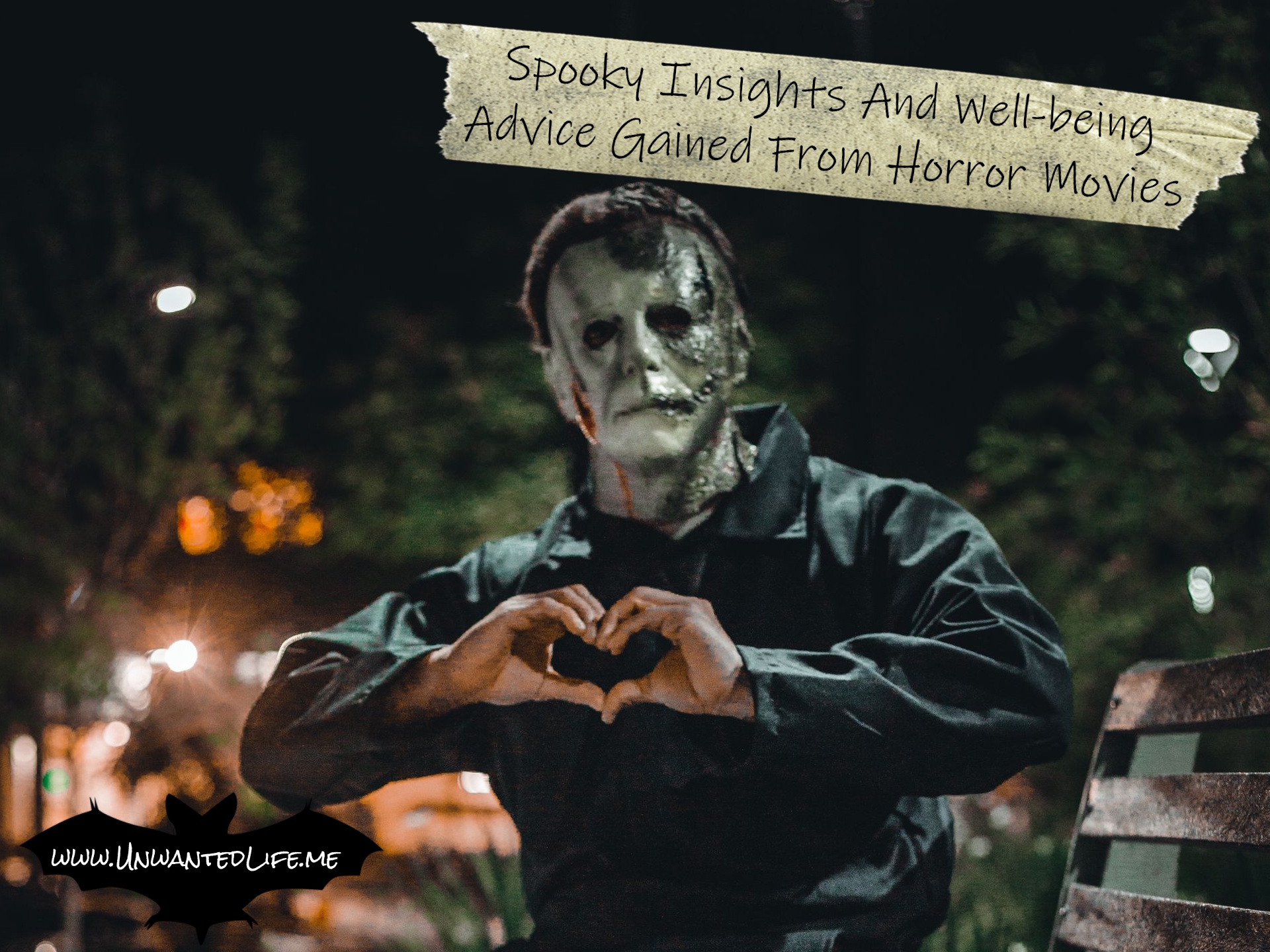
As we inch closer to Halloween, here’s a new instalment of my Halloween-themed content—a fun and unexpected way to look at self-care, wellbeing, and self-improvement. While horror movies are fictional, the survival tactics and character arcs of figures like the Final Girl offer some surprisingly relevant lessons for wellbeing and resilience. And that’s what we’re here to discuss today.
How Horror Movies Can Be A Source Of Self-Care And Wellbeing Advice
Although it might not always seem like it, horror movies are a way to feel terror while knowing we’re not in real danger, turning that terror into excitement and entertainment. This is exactly how amusement park rides work, such as rollercoasters and haunted houses (King, 1981).
According to Sally Winston (licensed psychologist and executive director of the Anxiety and Stress Disorders Institute of Maryland), speaking in an interview for Healthline (Vinall, 2020), no harm comes from watching horror movies when we’re able to process the illusion they’re creating.
This is one of the reasons movie ratings exist: children may not be able to process the horror movie as being an illusion separate from reality, meaning a 10-year-old may not be able to understand that they’re safe watching a horror movie rated 18.
It’s that ability to understand that the horror we’re watching doesn’t mean that we’re in danger that we can learn from these experiences.
Horror Movie Trope: Final Girl
One of the most successful and popular horror movie tropes (slasher movie) is that of the Final Girl. A Final Girl is the character who denotes the last surviving female protagonist who typically confronts the killer and lives to tell the tale. Think Ellen Ripley from the Alien films, Laurie Strode from the Halloween films, and Sidney Prescott from the Scream films.
For many people, the Final Girl trope is a symbol of survival, hope, and resilience that they find inspiring (Little, 2024). So, what can we learn from these famous Final Girls?
Trust our instincts
Characters like Laurie Strode from Halloween or Sidney Prescott from Scream are often the first to sense that something is deeply wrong. In the case of Ellen Ripley, she was the first to realise that the signal detected in the first Alien film might be a warning, and she was also the one trying to impose strict quarantine rules, which were overruled. In the rest of the franchise, it becomes Ellen Ripley’s role to warn people of the danger while that warning is ignored.
So what can we learn from this? Listening to our gut feeling can be useful to us, because it’s often our subconscious realising something before our conscious mind does.
In real life, that uneasy feeling often signals a bad situation, a toxic relationship, dating and relationship warning signs (red flags and yellow flags), or a decision that isn’t right for us. Ignoring internal warning signs in favour of politeness or “going with the flow” can be detrimental to our wellbeing and safety.
Stay level-headed under pressure
When chaos erupts in a horror movie, such as when Jason Voorhees slashes his way through a school trip’s worth of high school teens, the survivors are the ones who can regain their composure and start to think rationally, locate tools, and form a plan, rather than succumbing entirely to panic.
What we can learn from this is that emotional regulation and calm problem-solving are important skills to master. When facing real-life crises (stressful deadlines, arguments, and major life changes), the ability to pause, take a breath, and focus on one practical step at a time is crucial for our mental wellbeing and taking effective action.
Resilience
When all hell breaks loose and Freddy’s coming for you, that doesn’t mean the Final Girl doesn’t experience a lot of terror, fear, and anxiety throughout the movie (Slasher Wiki, n.d.). No one is born with strength and resilience; that’s something we learn.
What we see happen is a form of resilience being built as part of their character development. This allows them to tackle the object of their fear head-on, as they know it’s the only way to bring it all to an end. It’s not easy to turn and face our fears, but when it comes to conditions like anxiety and trauma, that’s often the best way to overcome them and gain much better long-term outcomes and improve our quality of life.
Survival is rarely a matter of pure luck. So much like in horror movies, it comes from learning, adapting, and using whatever tools or environment are available with tactical precision. It pays to be resourceful (Slasher Wiki, n.d.).
This matters because we don’t want to be like Tatum Riley trying to escape through a cat flap (Hannahissopotterlike, n.d.). We’ll often see the first plan fail as they try to figure out a way to overcome the situation. Trying to fit through a cat flap was a plan that failed.
Life will present unexpected obstacles. The ability to pivot, learn a new skill quickly, or creatively use the resources we do have (even if they feel inadequate) is a vital skill for personal growth and thriving.
Leading the survivors
When we’re the Final Girl, we’re often not listened to until it’s too late. Time and again, that’s because the Final Girl hasn’t built up the resilience and strength to make themselves heard in the face of opposition.
In life, we often have to stand up and put our point and concerns across despite opposition. We all have a right to our opinions and to be heard, but often the loudest person dominates this. But just because someone is the loudest doesn’t mean they’re right.
It’s the same when it comes to our relationships. If we want to get the most out of life, it’s best to make sure we’re an equal partner in everything, so our needs and wants are also factored in.
What Else Can We Learn From Horror Movies
Confront our fears
Horror movies can be a safe way to confront our fears (Vinall, 2020). How this can be done can vary from person to person, but for anxiety disorders it could make up part of an exposure therapy plan. It could be incorporated into one of the steps to challenge the fear our anxiety feels it’s protecting us from, but which is now nothing but a source of our problems instead.
Don’t split up!
In the majority of horror films, the characters end up splitting up, and then the majority of them die. Anyone who’s watched more than one horror movie will be very familiar with this. It’s basically like in a war film when someone talks about their family or their plans for after the war; they’re going to die.
In the awesome film that is The Cabin in the Woods, we get to see this being played out in an unfamiliar yet creative way.
Characters who stick together, communicate, and look out for one another stand a much better chance. Just like we do in real life. Thus, the lesson is that the better our social support network is, the less we isolate ourselves, which leaves us less vulnerable.
Surrounding ourselves with trusted people who support us without judgment is a powerful protective factor against stress, trauma, and mental distress. It’s also great to be that safe space for others as well.
Don’t run from our past
In a lot of horror movies, there is often a moment where the characters need to face their inner demons. In many supernatural horrors, unresolved guilt, grief, or trauma (sometimes embodied by the monster) comes back to haunt the characters. Ignoring the problem only makes it stronger. But facing it sets them free.
Unhealthy guilt, unresolved grief, and unprocessed and ignored trauma often eat us up inside. Therefore, the lesson is not to let it consume us but to do something about it. I know I had to look my childhood trauma in the eyes and process it to stabilise my very unstable mental health, and it was the first step in my borderline personality disorder (BPD) getting better.
Substance misuse
A common indicator that you’re doomed to die in a horror movie is drinking and doing drugs (Scream Wiki, n.d.), most famously commented on in the Scream movies. Randy Meeks comments on how this is rule number 2.
Now I like a drink or two from time to time, and I certainly have my own history with drugs. But I also know that I used both to self-medicate, and that is harmful to us. I abused both so much I developed drug-induced psychosis.
The lesson. We can’t escape from our problems or paper over our trauma by getting fucked out of our faces all the time. That way leads to a bleak existence. Substance dependency is life-destroying, and not just for us, but for those around us as well.
Find healthier ways to manage, such as seeking professional help, relying on our social support network, and finding healthy ways that work for us to overcome the pain inside.
Summary
So there you have it. Even something created to entertain us by scaring us can be a source of valuable wellbeing advice if we pay attention. For example, when we see the Final Girl go from a passive victim to the circumstances, to building resilience, coming up with a plan, and finally surviving the chaos that comes with horror movies.
And that’s the same for all of us. It’s how we deal with the things that pop up in our lives that makes the most difference. Stuff like avoidance and thought suppression only worsens our mental health.
Learning how to handle bad news or a bad situation like an unstoppable Jason Voorhees, who isn’t actually unstoppable, is how we survive life and live the best quality of life we can.
As always, leave your feedback in the comments section below. Also, please share your experiences with learning something from the horror movies you’ve enjoyed in the comments section below. Don’t forget, if you want to stay up-to-date with my blog, you can sign up for my newsletter below. Alternatively, click the red bell icon in the bottom right corner to get push notifications for new articles.
Lastly, if you’d like to support my blog, please find the PayPal and Ko-fi donation payment options below. Until next time, Unwanted Life readers.
References
Hannahissopotterlike. (n.d.). How to survive horror movies – How to survive horror Movies – Scream. Wattpad. Retrieved from https://www.wattpad.com/2306557-how-to-survive-horror-movies-scream.
King, S. (1981). Why we crave horror movies. Across Cultures, 497-99. Retrieved from https://kerryclark10504.wordpress.com/wp-content/uploads/2013/08/stephen-king.pdf.
Little, E. (2024, October 28). Cinematic Survivorship: What The Final Girl Trope Teaches Us About Gender, Trauma, and Resilience. Deep Eddy Psychotherapy. Retrieved from https://deepeddypsychotherapy.com/cinematic-survivorship.
Slasher Wiki. (n.d.). The Final Girl. Fandom. Retrieved from https://slasher.fandom.com/wiki/The_Final_Girl.
Scream Wiki. (n.d.). Scream: The Rules. Fandom. Retrieved from https://scream.fandom.com/wiki/The_Rules.
Vinall, M. (2020, October 6). Can horror movies negatively impact your mental health?. Healthline. Retrieved from https://www.healthline.com/health/how-do-horror-movies-affect-your-mental-health.