
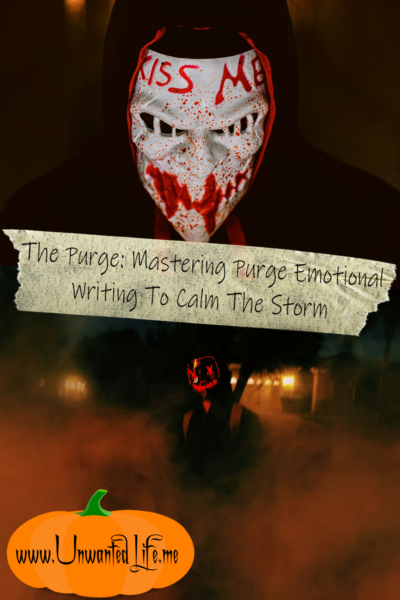
I don’t know if you noticed, but I snuck the title of a good horror film, The Purge, into this article’s title for Halloween. This also dictated the reason for this article. But it’s still a very useful article, so it’s a win-win. Hopefully, you’ll see why once you’ve read about purge emotional writing. Enjoy.
What Is Purge Emotional Writing
According to Salicru (2022), the purge emotional writing method was developed by James Pennebaker (Professor Emeritus of Psychology at the University of Texas at Austin). This approach, also known as written emotional disclosure, expressive writing, or writing therapy, is a therapeutic intervention in which we write about our traumatic or distressing experiences. But it also works with any kind of emotionally activating situation.
Emotional writing can serve as a powerful outlet for expressing our deepest thoughts and feelings. It allows us to release pent-up emotions, gain clarity, and find solace within the written word. Purge emotional writing takes this to the next level. It offers a space for us to unleash our emotions and turmoil onto the page without judgment or reservation.
By engaging in the purge emotional writing process, we can experience catharsis and embark on a journey of self-discovery. This might sound too easy and simplistic, but writing unfiltered when we’re used to filtering ourselves most of the time can be a game changer.
It doesn’t matter if we’re writing about traumatic experiences (Salicru, 2022), someone who rubbed us the wrong way, a life stressor (Salicru, 2022), or just purging our unwanted negative intrusive thoughts (Lee, 2012); the purge emotional writing process works with all of them and more.
I’ve used it to help process breakups and childhood trauma in my twenties. It really helped me to manage a lot of dark thoughts and the emotions I struggled to handle, which is really important when you have borderline personality disorder (BPD).
This makes for a great quasi-journaling exercise because it’s a form of self-expressive disclosure designed to process stress, neutralise negative thoughts, and support overall wellbeing (Sadeghi, 2023). It can even help bring to the surface emotions we’ve been suppressing (N.n., 2023). It’s also been shown as a therapeutic method in a few movies and shows over the years.
How To Try The Purge Emotional Writing Method
There are a couple of ways to use the purge emotional writing method. The two key differences between these methods are whether we create a time limit for how long we write and what we do with that writing afterwards.
But one thing that is needed is a pen or something to type on. So grab a pen and paper, or open a blank document, and delve into the cathartic art of purging emotional writing.
- Find a quiet and comfortable space where we can focus on our emotions and thoughts without distractions.
- If we want to use the time-bound version, then set a timer for 10 to 15 minutes. Some people recommends 12 minutes (PEW12; Sadeghi, 2023) for purge emotional writing . This time frame allows for an uninterrupted flow of emotions onto the page.
- Take a few deep breaths to centre ourselves and connect with our feelings and thoughts.
- Start writing without worrying about grammar, spelling, or structure. Let our emotions and thoughts guide our words.
- Permit ourselves to be raw, honest, and vulnerable. There is no right or wrong way to express our emotions and thoughts.
- Don’t censor ourselves. Allow our thoughts and feelings to flow freely, even if they seem irrational or contradictory, and swear as much as we need in the writing as well.
- If we find ourselves stuck or experiencing writer’s block, write the word “block” repeatedly until the words start to flow again. Although this might be more helpful in the timebound version.
- If we choose the timer method, keep writing until the timer goes off, even if we feel we have nothing left to say. Often, the most profound breakthroughs occur in the latter stages of the process.
- Once the timer goes off, we stop writing. If we’ve decided to go without the timer, keep writing until our mind starts to clear up and we have nothing left to say.
- Now that we’ve stopped writing, label the writing as trash, and throw it away or burn it (Lee, 2012; and N.n., 2023). However, there is an argument to be made for keeping what we’ve written, such as sharing it with a therapist. If we decide to do this, then it can also be useful to take a moment to reflect on what we’ve written. Notice any patterns, recurring themes, or insights that emerge.
The benefits of throwing away what we write are that we’re physically throwing out our unwanted thoughts. This is meant to help as it should mean these thoughts becoming less likely to influence us in the future.
Whereas, if we keep what we wrote, then we’re acknowledging that these thoughts have some form of great importance. Thus, they may have greater influence on us (Lee, 2012).
Summary
Purging emotional writing can be an incredibly liberating experience. By giving voice to our emotions and negative thoughts and allowing them to flow freely onto the page, we create space for healing, understanding, and personal growth.
Through this process, we may gain valuable insights, find relief from emotional burdens, and discover new perspectives on our experiences. Or it just might be a very healthy way to offload things and move on.
Embrace the power of the written word and embark on this transformative journey of self-expression. Let the words flow and witness the beauty that emerges from the depths of our emotions and inner world.
As always, leave your feedback in the comments section below. Also, please share your experiences with the purge emotional writing method in the comments section below. Don’t forget, if you want to stay up-to-date with my blog, you can sign up for my newsletter below. Alternatively, click the red bell icon in the bottom right corner to get push notifications for new articles.
Lastly, if you’d like to support my blog, please find the PayPal and Ko-fi donation payment options below. Until next time, Unwanted Life readers.
References
Lee, J. (2012, November 28). Research: To purge negative thoughts, just write them down and throw them in the trash. Choose Help. Retrieved from https://www.choosehelp.com/blogs/emotional-health/research-to-purge-negative-thoughts-just-write-them-down-and-throw-them-in-the-trash.
N.n. (2023, February 28). 3 techniques to start journaling for better well-being. When They Get Older. Retrieved from https://whentheygetolder.co.uk/quality-of-life/pastimes/hobbies/3-techniques-to-start-journaling-for-better-well-being.
Sadeghi, H. (2023). Hypnotherapy and purge emotional writing for chronic disease management. The Medical Journal of Southern California Clinicians, 16(1). Retrieved from https://socalclinicians.org/periodical/2023_Hypnotherapy.pdf.
Salicru, S. (2022, March 8). Write your negativity away and feel better. Psychology Today. Retrieved from https://www.psychologytoday.com/us/blog/psychology-insights-for-a-new-world/202203/manage-negative-emotions-using-written-emotional.
I agree with the method Professor Pennebaker develop. Emotional writing does help me reduce my anxiety and overcome my stress. I use emotional writing in journal and sometimes in novels. Most of my readers said my novels have a very honest and raw writing style that makes them can feel me and my characters well. I’m grateful for that ^_^
It’s interesting to know it helps you with your novels as well. Thank for sharing