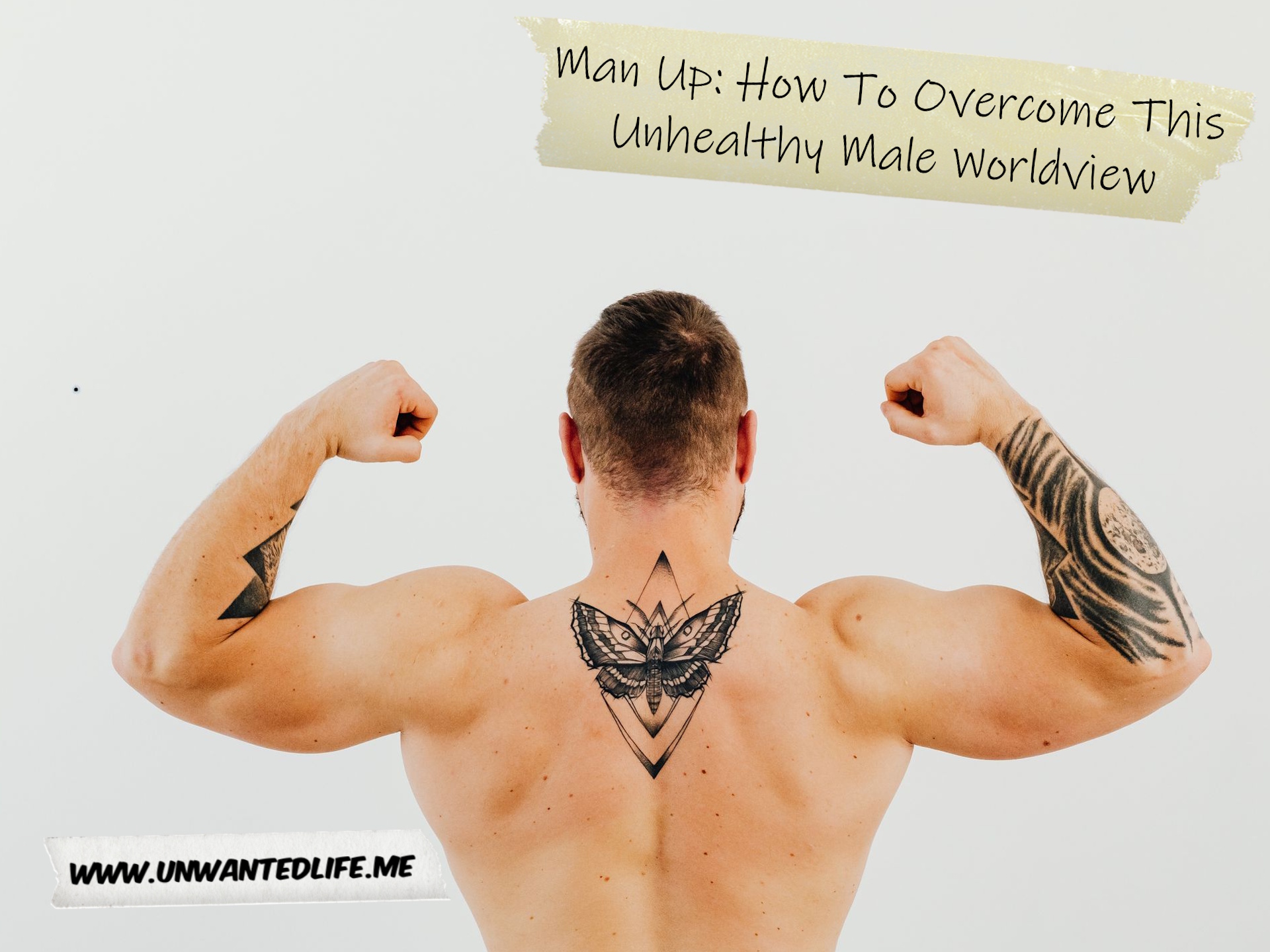
I’ve heard the phrase “man up” a lot over the years, and I’m ashamed to say I’ve also said it once or twice, back in the day. All the more reason to write this article, because we need to move away from such phrases and embrace a more inclusive way of being.
What Does It Mean To “Man Up”?
To make an effort to deal with something (such as an obligation or a challenge) in a way that is considered strong or manly
The phrases “man up” and “manning up” typically imply the expectation that men (and people who identify as male) exhibit traditional masculine traits such as strength, emotional stoicism, and self-reliance.
Thus, cultural masculinity, which personifies the “man up” phrase, is the pressure to exist in ways that are stuck in rigid, society-defined, sex-appropriate ways (Kilmartin, 2005), but that doesn’t mean it’s appropriate for us, or anyone else, for that matter.
However, these expectations to conform can lead to several issues. The phrase “man up” is a harmful and outdated social norm that can have a negative impact on men’s mental health and wellbeing. It promotes a narrow and unrealistic view of masculinity that can lead to men (and people who identify as male) suppressing their emotions, avoiding seeking help, and feeling ashamed of their vulnerabilities.
The issues with the phrase “man up”:
Suppression of emotions
The expectation to “man up” can encourage men or people who identify as male to bottle up their emotions, such as sadness, grief, and fear. That it’s somehow wrong to show vulnerability. The consequences of this can lead to emotional distress, increased stress, and difficulty forming healthy relationships. It can also mean such people will suffer in silence rather than seeking the help they need.
Avoidance of help-seeking
Men and people who identify as male may hesitate to seek help from their social support network or professional help for mental health issues or other challenges due to the fear of being perceived as weak or not “manly”. This can delay treatment and hinder recovery.
Because of this, it reinforces the idea that certain traits or behaviours, such as avoiding vulnerability or seeking help, are unmasculine, perpetuating harmful stereotypes and behaviours. AKA, causes the development of a toxic masculinity worldview.
It goes without saying that avoiding seeking support, medical help, or ignoring health concerns due to the pressure to “man up” can be extremely detrimental to that person’s wellbeing and quality of life, but can also affect the people around them.
Mental health stigma
One of the reasons I started this blog was to help challenge mental health stigma, because although it has got better since I was a child, there is still stigma regarding mental health. Such societal pressure to “man up” may contribute to that stigma around men seeking help for mental health issues, leading to underreporting and untreated conditions.
A problem that is made even harder in the US because of how its healthcare system works.
Shaming of vulnerabilities
These kinds of phrases can contribute to a culture of shame and stigma surrounding men and people who identify as male, emotional expression and vulnerability. This can prevent men from seeking support from others and can isolate them from their social support network. Shame is a very powerful emotion.
Limited expression
The notion of “manning up” can restrict men and people who identify as male from embracing a full range of emotions and behaviours, limiting our ability to connect deeply in relationships or experience emotional fulfilment. It’s a form of masking.
When has it ever helped any of us to ignore individual differences in trauma, thought patterns, brain chemistry, and life experiences that profoundly shape reactions?
One of the main issues with “manning up” and masculinity is the fear that comes with deviating from these unhelpful male norms, where people fear the loss of status and power (Schlichthorst, King, Reifels, Phelps, and Pirkis, 2019), or being seen as somehow weak.
Unrealistic expectations
The concept of “manning up” promotes an unrealistic and unattainable standard of masculinity. Men and people who identify as male may feel inadequate or insecure if they don’t meet these expectations, leading to self-esteem issues and low self-worth.
When we have the idea in our heads that we must be pillars of physical and mental strength who never struggle imposes unfair expectations. Parents, both male and female, can often find themselves doing this as well for the sake of the family, which also isn’t healthy.
Denying and hiding from our struggles doesn’t even make us strong; tackling them is where we build resilience, rather than pretending they don’t exist. Plus, why should we be bound by someone else’s idea of what it is to be male?
Abuse
All that repression and denial about the struggles of men and people who identify as male doesn’t make these unwanted intrusive thoughts and feelings go away. They often come out in other ways, and those other ways are rarely healthy. What’s worse is that it can lead to excuses for abusive anger.
The “man up” attitude is sometimes a rationalisation for risky behaviours, aggression toward self/others, and domination mindsets rooted in avoidance of fragility. This is toxic masculinity, when what we want is growth. While resilience has merits, the common usage of “man up” promotes repression over health.
Reinforces outdated gender roles
There is no one way to be a man, to be a woman, to be a person. I grew up during a time when there was a huge push to ditch gender roles completely, but unfortunately, decades later, this is still an issue. And in certain countries, it’s even the basis of a culture war, for some reason. Where certain people are trying to put men and women back in their gender role boxes and close the lid.
Why are we trying to create a world that lacks compassion and nuance? How does trivialising complex personal issues as temporary setbacks that can be willed away help anyone?
“Man Up” Masculine Norms
Here’s a list of the unhealthy masculine norms that currently plague us at the moment, according to Mahalik et al. (2003) and as outlined in the study by Iwamoto, Cheng, Lee, Takamatsu, and Gordon (2011):
- Winning: Striving to win at all costs.
- Playboy: Showboating our sexual prowess.
- Emotional control: Controlling one’s emotions.
- Risk-taking: Engaging in risk-taking behaviours.
- Violence: An inclination towards physical aggression.
- Dominance: Asserting influence over situations.
- Self-reliance: Proclivity towards unhealthy levels of independence.
- Work: Regarding work as the main priority in life.
- Man of the house: Controlling women.
- Heterosexual presentation: Aversion to being perceived by others as being gay.
- Status: The desire to be important in society.
This is a problem on many levels, because men and people who identify as male can also try to overcompensate for their fragile masculinity by becoming risk-takers (Schlichthorst, King, Reifels, Phelps, and Pirkis, 2019), and by acting more aggressively.
Why It’s Important To Ditch Harmful Phrases Like “Map Up”
Unfortunately, social norms influence people in what ways we should behave. While in some cases that is fine, like following the law (if it makes sense, so not stuff like slavary which was legal), when it forces us into gender roles, then it’s a problem. Unhealthy masculine roles in society can increase these unhealthy ways of being, getting adopted by others, both by men and women.
When I was growing up, men wearing pink was unthinkable; yer pink started out as a boys’ colour and blue was for girls, until those were switched in the 1940s (Maglaty, 2011; and LoBue and DeLoache, 2011). In the last decade, men in pink shirts and pink ties have become common.
Pink is also one of my favourite colours. But when you’re brought up on a diet of how we think men “should” be, it can be a tough thing to unlearn. So when we’re told “boys don’t cry”, this can become incorporated into what is expected of us as a man (Mahalik et al., 2003), which sucks.
One of the main ways to see the concept of “manning up” and the unhealthy masculine culture that exists is in how we consume alcohol. A study by Iwamoto, Cheng, Lee, Takamatsu, and Gordon (2011) looked into drinking culture among American college students and noted that men faced elevated risks of problematic drinking and negative alcohol-related consequences when compared to female college students. Because there was a culture of excessive drinking.
This echoes my own personal experience, where there’s more of an expectation for young men to drink heavily and be able to hold their drink. At the time, I was very much part of this problem as well. But now that I’m more mature, I’m the exact opposite. I encourage and support people to only drink what they want to drink and to stick to their limits.
Evidence shows time and again that depressive symptoms in men are too often undiagnosed and untreated, because men find it hard to articulate their inner struggles, and because of the unhealthy expectations of masculinity (Emslie, Ridge, Ziebland, and Hunt, 2006).
It’s also important to know that because of these outdated masculine ideas that come with a “man up” culture, depression can manifest in different ways than it does in women.
For men, it can show up in a bad temper and aggression, as this is one of the few “acceptable” emotional outlets for a manly man, which also means there’s a risk of abusive behaviours, getting overly involved in work (or sports), and sexual risk-taking and other risk-taking behaviours (Kilmartin, 2005).
Globally, there is gender inequality when it comes to suicide. Australia is no different, with male suicide being three times higher than female suicide, and this discrepancy has been suggested to be caused by masculinity, or the rules prescribed by societal norms about how men should live their lives (Schlichthorst, King, Turnure, Sukunesan, Phelps, and Pirkis, 2018).
Things can get more complicated for men and people who identify as male when eating disorders come into the mix, as historically, eating disorders have been seen as a female condition.
As someone who has struggled with an eating disorder in one form or another for the last 26-odd years, it can be hard to get male eating disorders to be taken seriously. This was also the case for Daniel Magson and his bulimia battle, an article I saw in Men’s Health, which I wrote about in an article for my blog: One Man’s Battle With Bulimia: An Article Discussion.
When we create the idea that men and women should act in certain ways, we create a barrier for men and women to act in ways that differ from this expectation. With traditional gender roles and stereotypes, we expect men to be emotionless and strong, while women are seen as emotional.
Thus, for men to be emotional is to be like a woman, which just isn’t true. But it gets worse when we subscribe to these views: men are meant to be the breadwinner while women are meant to be mothers, but again, that’s not the world we live in.
Some women love sports and play sport professionally, and some men don’t like sport and don’t even like playing sports at all. But that has no bearing on what gender a person is, yet some people in society still struggle with this, which is mind-blowing.
Because some men and people who identify as male may find themselves trapped by outdated ideas of masculinity, they may be told to just “man up”; men can then find themselves having to cope in unhealthy ways, such as drinking, which can quickly turn into substance dependency issues (Kilmartin, 2005). How many households suffered at the hands of broken veterans after World War II who turned to drink to deal with their trauma?
Ditching “Man Up”
Encouraging a more inclusive definition of masculinity that values emotional intelligence, vulnerability, and seeking support can help address these issues. Although I’d argue that ditching gender roles altogether is where we really need to be.
Emphasising the importance of being emotionally open, seeking help when needed, and promoting healthy coping mechanisms can create a more supportive environment for men and people who identify as male concerning their mental and emotional health.
Instead of using phrases like “man up”, consider using more supportive and inclusive language that encourages men and people who identify as male to express their emotions, seek help when needed, and embrace their vulnerabilities. After all, that’s the bravest thing we can do. Here are some examples of more constructive alternatives:
“Be strong in the way that is best for you”
The idea that men and people who identify as being male can only be seen as strong by following this outdated and extremely narrow understanding of what it means to be a “man” is ludicrous. There are many, many ways to be strong.
By using a phrase like “Be strong in the way that is best for you”, it acknowledges that strength comes in different forms and encourages men and people in general to find their own path to resilience.
By redefining strength to include nonjudgmental processing of struggles lifts heavy gender constraints. We all benefit when seeking help is encouraged, not stigmatised as weakness. After all, there’s no reason why there should be one definition of being a “man”; there’s no reason we should have these male and female roles at all.
The LGBTQIA+ community has a strength no toxic masculine male could ever have, as they’re normally the most fragile among us. I envy the ability to be as free to be true to themselves as many people in the LGBTQIA+ community in the face of some very extreme discrimination. I have a friend who’s a drag king, and I wish I could think, fuck it, and be that free like they are. They don’t mask for anyone.
When I get asked why I paint my nails black, something I don’t do as often as I used to, I’d often come back to how it takes strength to step outside that masculine box that limits our quality of life.
By challenging adherence to these dominant yet outdated masculine norms, we can help increase men’s (and people who identify as male) willingness to seek help when they’re struggling, and reduce the much higher male suicide rates (Schlichthorst, King, Reifels, Phelps, and Pirkis, 2019).
“Be yourself”
There’s only one us, and while it’s fine to want to be the best version of us, as growth should be a lifelong goal, being ourselves also encourages men and everyone else to embrace their authentic selves, regardless of societal expectations. I often have this conversation with my clients, as masking, for whatever reason, drains our spoons and hinders our chances at being happy.
There is no right or wrong way to be a man, to be a woman, to be a person. If we can’t change a car tyre, that doesn’t somehow mean we’re not a man. How arbitrary is that? This isn’t 1950s America, where men spend their free time working on a car rather than spending quality time with their family.
We need to stop propagating harmful gender stereotypes and gender roles, and finish what started when I was a child, and abolish these altogether.
“Seek help when you need it”
Men often see seeking help as a measure of weakness or failure, but this stoic behaviour can have lethal consequences and can increase the likelihood of suicidal thoughts (Schlichthorst, King, Turnure, Sukunesan, Phelps, and Pirkis, 2018).
As a therapist, and as a person who’s been through a lot of shit, it’s always important to normalise seeking help and encourage men and everyone else to prioritise their mental and emotional wellbeing.
“It’s okay to be vulnerable”
Too many of us think it makes us weak to show any kind of vulnerability, even though it takes a serious amount of courage and strength to be vulnerable. Thus, such a phrase helps validate men’s and everyone else’s emotions and encourages them to express their feelings without fear of judgment. This is something I often have to challenge with my clients, so they make use of their social support networks.
When it comes to supporting men with depression, it’s been suggested that it’s important to help create a narrative that works within masculinity, such as conceptualising the struggle not as a form of weakness, but as a way to become a stronger person (Emslie, Ridge, Ziebland, and Hunt, 2006). Something I’ve done many times with male clients.
When “Man Up” Goes Too Far. The Warning Signs
We’ve created a world where it’s hard for men to open up, when it shouldn’t be hard for them to do so, all because of silly phrases like “man up”. This is one of the reasons suicide is high among men, so what do we need to be aware of to further help with this? Well, according to Whittle (n.d.), writing for the UK charity Tough To Talk, there are some of the signs to pay attention to in men:
Social withdrawal
One of the worst things any of us can do is to distance ourselves when we’re struggling. Unfortunately, this is a common response in men, often because they’ve not maintained their social support networks, as women are more likely to do.
Thus, if we notice the men, or anyone, in our lives becoming more distant and avoiding social situations they’d usually enjoy, then this could be a sign that something is bothering them.
Giving away belongings
When someone feels hopeless and is in a state of despair, they may start giving away their possessions to family and friends as if they’re saying goodbye, because they might be saying goodbye.
Risk-taking behaviours
When we stop caring about consequences, we can start taking risks and doing dangerous activities without fear of consequences, because survival doesn’t matter. I can testify to this as being my personal experience as well.
When I became suicidal, I became stupidly reckless. Taking large quantities of drugs and mixed dangerous levels of drugs because I hoped it would kill me. I also did other stupidly dangerous things as well. I’m still shocked to this day that I survived all that.
Seeking access to weapons
There can be an increased fascination with weapons; in the US, this could be a desire to buy a gun or an increase in firearms purchases. In places like the UK and everywhere really, it might be an attempt to acquire weapons from others or knives.
Again, speaking from my personal experience, I built up a large collection of knives and swords in my time of frequent distress, suicidal ideation, suicide attempts, and self-harming.
Talking about death
Talking about death more than usual or frequently referring to dying can be a warning sign that something is wrong with someone. I would also argue that a more nihilistic outlook can be a warning sign too, as it may not be overtly talking about dying, but more about the meaninglessness of life. Again, this is something I know happens from my own personal experience.
Poor self-care habits
When you’ve lost hope or are struggling, it’s easy to start neglecting self-care habits and personal hygiene habits, such as not showering regularly or not eating enough. Why bother with such things if life has no meaning? Changes to self-care and hygiene habits can be a good indication that someone is struggling. Yep, this has been me too.
Increase substance use
As already stated several times, men, as well as people in general, can turn to alcohol or drugs to manage their issues as a form of unhealthy coping strategy. Unexpected changes in substance use are a red flag for suicidal behaviour because of this, and because of the increase in risk-taking behaviours. And god, did I love my drugs and alcohol when I was dwelling in my pit of despair.
Thus, if someone begins drinking heavily or using drugs more often, they may be using these as a way to cope.
Loss of interest in things
It’s hard to have an interest in things, even the things we enjoy, when we’re drowning in our own struggles. Thus, if we notice that someone in our lives doesn’t have the same enthusiasm for hobbies or other interests they used to enjoy, then this could indicate depression, stress, and burnout, and increase the risk of suicidal ideation and behaviour. For a very long time, I couldn’t even tell if I enjoyed anything or not; I was that emotionally numb.
Changes in sleep habits
This can manifest in several ways, from insomnia to oversleeping. Therefore, any significant change in sleeping patterns could be a warning sign, since sleep disturbances are often linked with suicidal thinking and actions. I’ve experienced many sleep issues during my dark days.
Webinar
While researching this article, I came across an organisation called MANUP? and a webinar that they’ve made available on their YouTube channel, so I thought I’d share it here too. It’s an insightful video and provides another way to get us all to stop using the term ‘man up’, as MANUP? seeks to rebrand that awful phrase.
Summary
The common phrase “man up” is problematic for several reasons, as outlined in this article. Mainly because it suggests suppressing emotions rather than processing them. But bottling up feelings in an attempt to be seen as a man breeds shame, anger issues, anxiety, and depression over time.
“Man up” is the phrase that summarises toxic masculinity, but it’s not just men saying it to other men, and that needs to be remembered as well. Women often use this phrase when talking to men too, especially as a put-down, and that’s also a problem.
Healthy masculinity involves taking emotions seriously through self-reflection, using our social support network, and even therapy. When problems arise, “manning up” discourages asking for assistance and instead places sole responsibility on the individual to power through alone. But everyone benefits from support during hard times. So why deny ourselves that support?
As always, leave your feedback in the comments section below. Also, please share your experiences with the phrase “man up”, toxic masculinity, and healthy masculinity in the comments section below as well. Don’t forget, if you want to stay up-to-date with my blog, you can sign up for my newsletter below. Alternatively, click the red bell icon in the bottom right corner to get push notifications for new articles.
Lastly, if you’d like to support my blog, please find the PayPal and Ko-fi donation payment options below. Until next time, Unwanted Life readers.
References
Emslie, C., Ridge, D., Ziebland, S., & Hunt, K. (2006). Men’s accounts of depression: reconstructing or resisting hegemonic masculinity?. Social science & medicine, 62(9), 2246-2257. Retrieved from https://doi.org/10.1016/J.SOCSCIMED.2005.10.017.
Iwamoto, D. K., Cheng, A., Lee, C. S., Takamatsu, S., & Gordon, D. (2011). “Man-ing” up and getting drunk: The role of masculine norms, alcohol intoxication and alcohol-related problems among college men. Addictive Behaviours, 36(9), 906-911. Retrieved from https://pmc.ncbi.nlm.nih.gov/articles/PMC3118921/pdf/nihms299559.pdf.
Kilmartin, C. (2005). Depression in men: Communication, diagnosis and therapy. The Journal of Men’s Health and Gender, 2(1), 95-99. Retrieved from https://www.researchgate.net/profile/Christopher-Kilmartin-2/publication/222574632_Depression_in_men_Communication_diagnosis_and_therapy/links/64b04eac8de7ed28ba960bfe/Depression-in-men-Communication-diagnosis-and-therapy.pdf.
LoBue, V., & DeLoache, J. S. (2011). Pretty in pink: The early development of gender‐stereotyped colour preferences. British Journal of Developmental Psychology, 29(3), 656-667. Retrieved from https://leestyercom410.wordpress.com/wp-content/uploads/2015/12/kami-export-pretty_in_pink.pdf.
Maglaty, J. (2011). When did girls start wearing pink?. Smithsonian Magazine, 7. Retrieved from https://leestyercom410.wordpress.com/wp-content/uploads/2015/12/kami-export-when-did-girls-start-wearing-pink.pdf.
Mahalik, J. R., Locke, B. D., Ludlow, L. H., Diemer, M. A., Scott, R. P., Gottfried, M., & Freitas, G. (2003). Development of the conformity to masculine norms inventory. Psychology of Men & Masculinity, 4(1), 3.Retrieved from https://www.academia.edu/78778719/Development_of_the_Conformity_to_Masculine_Norms_Inventory.
Schlichthorst, M., King, K., Turnure, J., Sukunesan, S., Phelps, A., & Pirkis, J. (2018). Influencing the conversation about masculinity and suicide: evaluation of the man up multimedia campaign using Twitter data. JMIR Mental Health, 5(1), e14. Retrieved from https://mental.jmir.org/2018/1/e14.
Schlichthorst, M., King, K., Reifels, L., Phelps, A., & Pirkis, J. (2019). Using social media networks to engage men in conversations on masculinity and suicide: Content analysis of Man Up Facebook campaign data. Social Media+ Society, 5(4), 2056305119880019. Retrieved from https://journals.sagepub.com/doi/pdf/10.1177/2056305119880019.
Whittle, S. (n.d.). The top suicidal behaviours that we commonly miss in men. Tough To Talk. Retrieved from https://www.toughtotalk.com/post/the-top-suicidal-behaviours-that-we-commonly-miss-in-men.