I’m so different to my mum, I’m almost the exact opposite of her in every way, and you could argue I’m her dark side, because I’m literally Black and she’s White. But I’m also just as different from the rest of my family. So I’ve always had the idea that I’m the black sheep in the family, but not in a bad way, and I thought that this might be interesting to explore in today’s article. After all. I’m not the only black sheep out there.
What Does It Mean To Be The Black Sheep
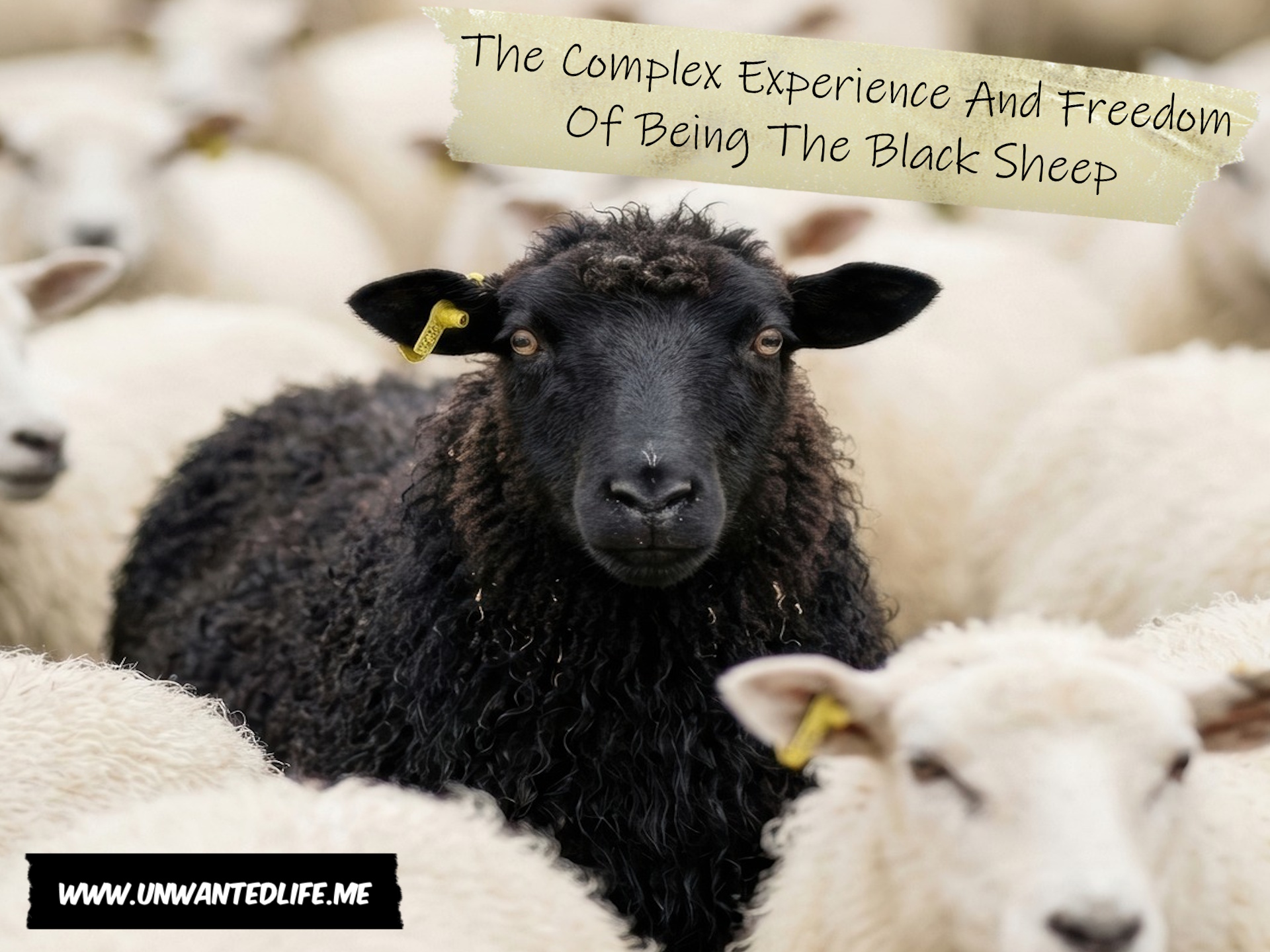
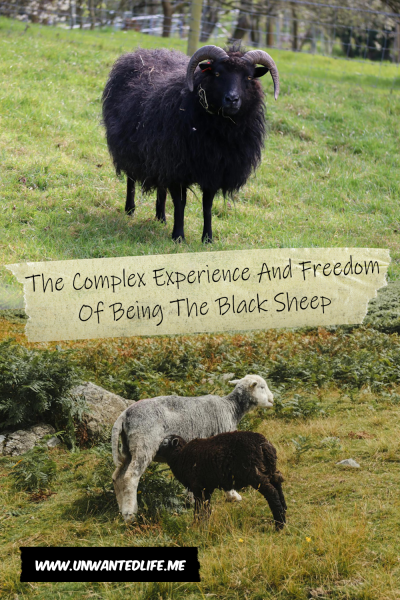
Being the black sheep is generally considered to mean that this person is the outcast of the family, the oddball (Webb, 2025). This can sometimes lead to the family believing the black sheep brought this upon themselves because they dared to be different.
Sometimes the black sheep may, in fact, be different, difficult, or problematic by some people’s or most people’s standards (Webb, 2025). For example, because of an undiagnosed mental health issue or attention-deficit hyperactivity disorder (ADHD). They could also have antisocial personality disorder, which may lead to that person violating the family’s and society’s boundaries. In such a situation, excluding this person to protect themselves from that person is the wise choice to make.
However, rarely is either of these scenarios actually the case. But what is true is that being the black sheep of a family or group is a complex experience. It often feels like a mix of isolation and a strange kind of freedom. While the term historically has a negative connotation, many people now view it as a badge of authenticity and courage. As I do.
Many black sheep are loving and caring people with much to offer. It’s more likely the case that they are often the best and brightest, are the most creative, or are the ones with the most powerful emotions (Webb, 2025). Or in my case, favour fact and reason over religious belief, and have been shaped by years of childhood trauma and neglect.
According to Pinto, Marques, Levine, and Abrams (2010), when we look at the concept of being a black sheep to being more than just a family dynamic, we can see the black sheep effect as a form of ingroup favouritism. This means we have to accept and reconcile the existence of undesirable ingroup members with the motivation to maintain a favourable view of the ingroup.
This often leads to group gatekeeping. An example of this is when we get quizzed about a band we like, asking for details that a die-hard fan knows, and if we fail, we’re not seen as a fan. Like, just being a normal fan is somehow wrong. Groups like this, in whatever form they may take, can mean it becomes almost impossible to become part of the ingroup (Travers, 2025).
According to Fitness (2004), when a child is perceived as disfavoured, this can lead to lower family cohesion, greater family disengagement, and higher levels of family conflict. This can also lead to feelings of shame within the disfavoured child.
Extending on group dynamics, when someone engages in a behaviour that is accepted by the group they’re in, this is positively reinforced by the positive evaluation of the other in-group members (Zouhri and Rateau, 2015). That also means that if we adopt a behaviour that is undesirable, we’ll be judged negatively by the in-group. In certain situations, we can be judged more harshly than an outsider engaging in the same behaviour.
The Dynamics That Result In A Black Sheep
Least in common with the parent
A child may stick out because of their personality, beliefs, temperament, or interests/hobbies. This can leave some parents baffled and inadvertently treating them differently, which, in some cases, can spread to this child’s siblings (Webb, 2025).
This is probably the one that best reflects my relationship with my parents. I rejected pretty much everything my mum believes, and found myself believing the exact opposite. I also never wanted to be anything like my dad. While my mum chooses faith over facts and reason, I choose reason and facts over everything else. I want to understand why things work, why people do the things they do.
My mum chooses bigotry because that’s what her faith has conditioned her to believe, and I choose inclusion even if I don’t fully understand the other person’s situation, because that’s a basic human right we should all have.
Pursue different paths
In some cases, we may choose a career, lifestyle, or partner that doesn’t align with the family’s expectations. Further hammering home how different we are from one or both of our parents. In some family dynamics, this can lead to being completely ostracised by our family for religious or cultural reasons.
Take it to the extreme, we can become the scapegoats of the family. We become the person everyone blames when things go wrong to avoid looking at their own issues. This can happen because it benefits the rest of the family to have one person take the blame for everything, as this allows for a form of solidarity and cohesion for them that otherwise wouldn’t be maintained (Fitness, 2004).
The best and the brightest
This child threatens to outperform or outshine one or both of the parents. Either consciously or unconsciously, the parents may sabotage the child to hold them back (Webb, 2025). This way, they won’t lose to them, and they won’t have to feel bad about themselves in comparison to the child. Another example of what makes comparisons so bad for us. No one should be in competition with anyone, let alone their own family or child. We should want our children to do better than us; that’s kind of the point.
Breaking cycles
We, as the black sheep, are likely to be the ones who address taboo topics like mental health, addiction, or toxic patterns that others prefer to ignore. This creates waves, which leads to discomfort, and people hate existing in discomfort.
Distance being created
There are many reasons why distance may be created; one such reason is ignorance. For example, when a child has intense or dark feelings/thoughts that the parents can’t understand. Thus, at a loss about how to help, they may just keep the child at a distance (Webb, 2025). An unwillingness to be supportive can also be a factor here, turning into parental neglect.
My childhood experience with racism and physical abuse at the hands of teachers left me with a lot of emotions to handle. As well as depression and bouts of anxiety. But when I reached out to my mum for support, I was met with none at all. So I never reached out again. As a result, I was suicidal by the age of eight, and living with the knowledge that my mum would kill me if god asked her to. I was also told by her that I ruined her life by being born. So yeah, that distance can come into play for several reasons.
Different beliefs
We can maintain different political, religious, or social views that differ significantly from those of the group or our family, which can lead to us feeling like the black sheep. My mum and I are on opposite sides of this. Whereas I’m very much of the left, an atheist, and believe everyone has the right to try to live a happy life if they’re not harming others, my mum is very much on the right, religious, and parrots far-right sound bites and conspiracies.
Sibling rivalry
In some families, there simply isn’t enough attention or love to go around for whatever reason (Webb, 2025). One reason might be that one or both of the parents are limited in some way. Such as because of poor mental health, a personality disorder, or substance abuse. This may lead to siblings jockeying for whatever attention and love they can get. Equally, some parents go out of their way to compare their children to each other, creating sibling rivalry through this behaviour.
A parent who despises themselves
This parent can appear to be quite loving of their children, so this can be difficult to spot. But for some reason, they’re unable to tolerate certain aspects of themselves. These traits are then projected onto a chosen child or a child they see as having this hated side of themselves in, and they despise this child instead (Webb, 2025). This is an unconscious and unhealthy coping mechanism that happens outside of the parents’ awareness. Not that this is an excuse for treating a child like this.
Emotional neglect
It’s possible for a child or all the children in a family to be shown that their feelings don’t matter. That was something I learnt very early on. My emotions didn’t matter, but also that I didn’t matter at all. Such a message can have a devistating affect on such children, because they learn to repress and hide their feelings, and they learn that their needs and wants don’t matter. Failure to comply with this expectation can cause us to be pushed to the outside of the family group. To become the black sheep.
The Emotional Weight Of Being The Black Sheep
Living as an outsider in our own circle or family is rarely easy. We may become hyper-vigilant because we feel we always have to defend our choices. We might find ourselves falling into that scapegoat role as well. Most commonly, we just feel like we’ve let our family down.
Selective exclusion may become a common occurrence for us as the black sheep as well, whereby we’re not invited to events and only hear about events after they’ve happened. We can also feel more like a guest in your own family home.
Yet, there are also advantages to being a black sheep. We get to live an authentic life. One we’ve chosen for ourselves rather than the one expected of us. The expectations of us can be crushing, but that doesn’t mean those expectations are right for us.
Being able to live the life we want, we stop relying on external approval and validation, which helps improve our resilience. The freedom of not having to worry about conforming allows us to live without that pressure and allows for greater creativeity and personal freedom. Although that doesn’t always mean it’s stress-free, as our interactions with our family can trigger that stress. But at the same time, we can minimise such interactions or remove them altogether.
Breaking free from a dysfunctional family can also mean that the families we start and choose for ourselves can be so much healthier, stopping generational trauma. The most important step for any black sheep is realising that blood isn’t the only bond that matters. If your biological or original social circle doesn’t want to understand us, it’s an invitation to build a new found family.
Summary
Depending on the circumstances, being the black sheep can be either a bad thing or a good thing. What’s good about the latter is the freedom that it can bring for us, and its potential to drive change not only in ourselves, but in others as well.
Being the black sheep was the one thing that helped stabilise my sense of identity and my mental health struggles. It allowed me to find friends whom I care about and want to support, and find my calling in life as a therapist who wants to help others. I wear my black sheep status as a badge of honour. I’m also a metalhead for life!
As always, leave your feedback in the comments section below. Also, please share your experiences with being the black sheep in the comments section below as well. Don’t forget, if you want to stay up-to-date with my blog, you can sign up for my newsletter below. Alternatively, click the red bell icon in the bottom right corner to get push notifications for new articles.
Lastly, if you’d like to support my blog, please find the PayPal and Ko-fi donation payment options below. Until next time, Unwanted Life readers.
References
Fitness, J. (2004, November). Favouritism and rejection in Families: black sheep and golden-haired children. In Proceedings of the Australian Psychology Society’s (Vol. 63, pp. 63-67). Retrieved from https://www.researchgate.net/profile/Zoe-Hazelwood/publication/27481474_Attachment_Security_and_Intimate_Relationship_Satisfaction_The_Mediational_Role_of_Maladaptive_Attributions/links/54f645f00cf21d8b8a5c32d3/Attachment-Security-and-Intimate-Relationship-Satisfaction-The-Mediational-Role-of-Maladaptive-Attributions.pdf#page=63.
Pinto, I. R., Marques, J. M., Levine, J. M., & Abrams, D. (2010). Membership status and subjective group dynamics: Who triggers the black sheep effect?. Journal of Personality and Social Psychology, 99(1), 107. Retrieved from https://psycnet.apa.org/fulltext/2010-12776-007.html and https://www.academia.edu/12714193/Membership_status_and_subjective_group_dynamics_Who_triggers_the_black_sheep_effect.
Travers, M. (2025, February 25). 2 Subtle Ways ‘Gatekeeping’ Impacts our Lives—By a psychologist. Forbes. https://www.forbes.com/sites/traversmark/2025/02/25/2-subtle-ways-gatekeeping-impacts-our-lives-by-a-psychologist.
Webb, J. (2025, December 1). The unseen forces that turn a child into the family’s outcast. Psychology Today. Retrieved from https://www.psychologytoday.com/us/blog/childhood-emotional-neglect/202512/6-sad-reasons-why-a-family-creates-a-black-sheep.
Zouhri, B., & Rateau, P. (2015). Social representation and social identity in the black sheep effect. European Journal of Social Psychology, 45(6), 669-677. Retrieved from https://www.researchgate.net/profile/Patrick-Rateau/publication/280732936_Social_representation_and_social_identity_in_the_black_sheep_effect/links/5c8fb866a6fdcc38175c33f0/Social-representation-and-social-identity-in-the-black-sheep-effect.pdf.