I don’t know about you, but when it comes to my memory, my brain is like carrying water with a sieve. It’s a total waste of my energy and resources to try to brute force it with my mental efforts alone. I use a lot of tricks that fall into the cognitive offloading realm of getting through life. Today’s article will explore some of those tricks and explain why cognitive offloading might be the energy-saving hack your life is missing.
What Is Cognitive Offloading?
At its core, it’s a strategy to circumvent the inherent limitations of our working memory and memory in general, freeing up mental resources for more complex or creative tasks. Thus, cognitive offloading is the practice of using external tools or resources to reduce the mental effort it takes to perform a task, essentially outsourcing some of our mental workload to the world around us.
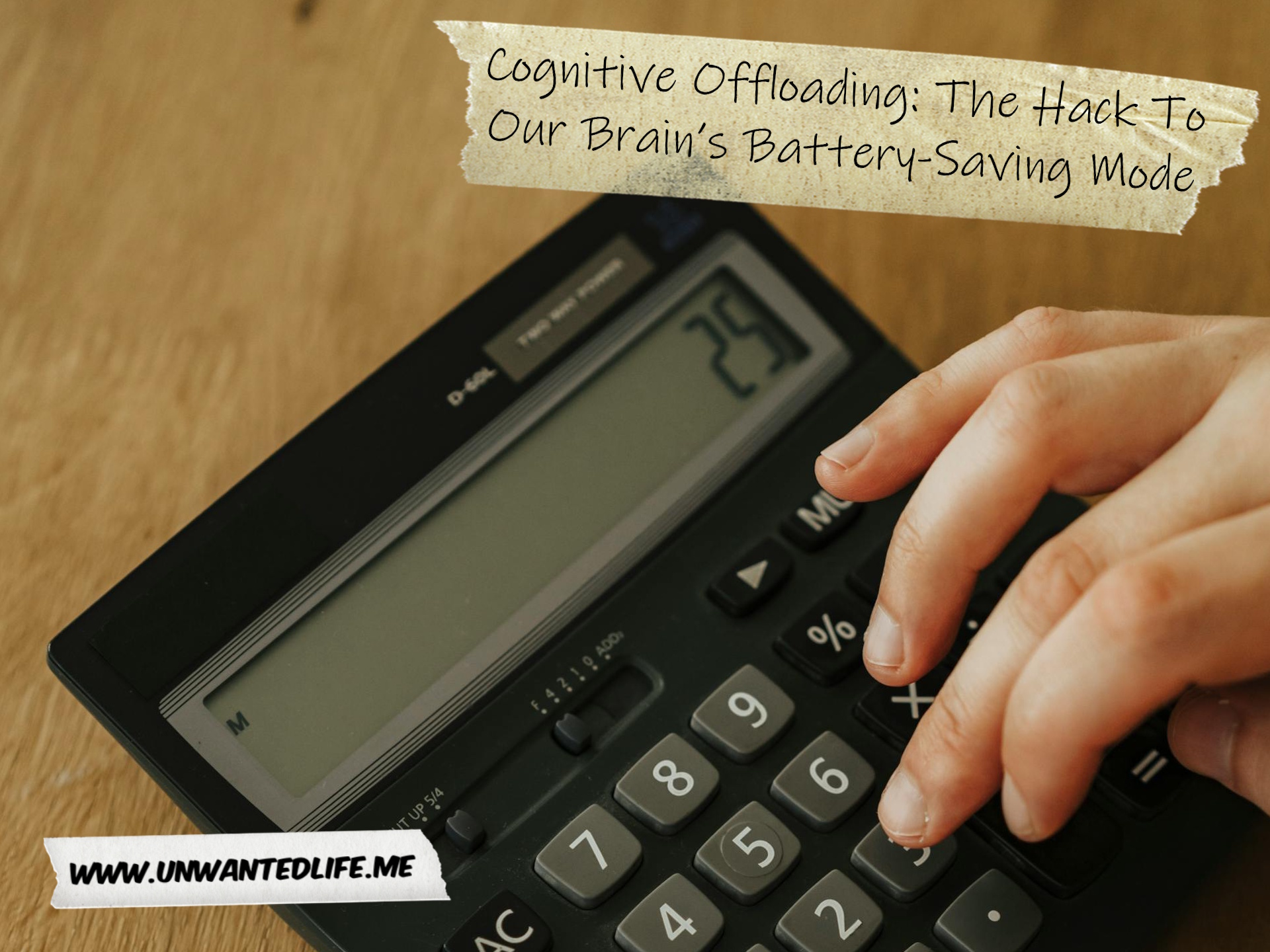
It involves a physical action (like writing, saving, or setting up the environment) that alters the information processing requirements of a task, reducing the cognitive demand on our brains. For example, using a journal to process events and emotions, setting up self-nudges, creating to-do lists (Armitage, Bulley, and Redshaw, 2020), or using a calculator for complex or even basic maths (I’m the latter for sure). The goal is to improve immediate task performance and efficiency by lightening the cognitive load.
This isn’t a new concept; humans have been using cognitive offloading for as long as history has recorded. The act of recording history is itself a form of cognitive offloading, as is counting on our fingers, using an abacus, and using a system of knots for memory (Risko and Gilbert, 2016). According to the Britannica (n.d.), a quipu was a knot-tying-based accounting apparatus used by Andean peoples from 2500BCE.
The world in which we live now has an untold number of options for cognitive offloading. All of which helps free us from the necessity of actively holding information in short-term representations (Grinschgl, Papenmeier, and Meyerhoff, 2021). I don’t know how I’d function without my smartphone and its calendar (Risko and Gilbert, 2016) or the Finch app.
The Argument Against Cognitive Offloading
While cognitive offloading can free our mental resources for other things, it has been argued that it might also cause a decline in our skill development and cognitive engagement (Gerlich, 2025).
Grinschgl, Papenmeier, and Meyerhoff (2021) expressed that cognitive offloading will accelerate task processing, but it can also interfere with the formation of the process information as a memory. This is why we were told in the 80s and 90s to do maths without a calculator. But even using pen and paper or counting on our fingers is a form of cognitive offloading.
Yet, a lot of the things we now understand in science, the universe, and mathematics, or the things we rely on today, likely wouldn’t exist without cognitive offloading. Supercomputers in research exist for a reason.
Another potential negative of cognitive offloading is overloading ourselves with tools. It can become a problem if our offloading tools (apps, lists, planners) become so numerous, disorganised, or demanding that they add to our stress. It’s possible to cause ourselves to feel burnt out because of this, which undermines the reason for using cognitive offloading. It’s also worth considering what would be done if the tool we rely on isn’t available.
There are ways to get around some of these negatives, such as regularly reviewing the cognitive offloading tools we use, so we’re not overdoing it. We can also think about the purpose of the task we may use cognitive offloading tools. According to Grinschgl, Papenmeier, and Meyerhoff (2021), if the task requires quick performance, then using such tools would be recommended, but if the task requires some form of memorisation or learning, avoiding offloading where possible would be a better approach.
Cognitive Offloading For Mental Health
When cognitive offloading is applied to wellbeing and self-care, it can become a key strategy for managing mental load and preventing burnout. The goal is to outsource the mundane, repetitive, or non-essential mental tasks to free up energy for emotional regulation, reflection, and restorative activities and hobbies.
With establishing the core benefit being stress reduction. Then, when we reduce the amount of information our working memory has to juggle, we can lower our overall cognitive load, which is directly linked to feelings of anxiety, overwhelm, and mental fatigue. As the spoon theory tells us, we only have so much mental energy available.
Offloading mental to-dos
This is the most direct application, and one I recommend a lot to people and my clients. The mind can be constantly cycling through things we have to do, which is known as the Zeigarnik effect (the tendency to remember uncompleted tasks). But by offloading these tasks, we free ourselves from this.
There are several ways to do this. We can create a to-do list in an app or in a notepad, we can keep a journal, set calendar reminders, or we can use other apps. Any chore or task we need to remember, we just add it to whatever external memory source we’re using. This allows the brain to know it no longer needs to remind itself of these tasks because they’re safely stored elsewhere. Thus, reducing intrusive thoughts.
Offloading emotional processing
This is the OG self-care activity: keeping a journal. Physical writing is the best option, but a digital or vlog approach can also work. By doing this, it works as a brain dump for our fears and the like, but it also slows our thinking down, making those thoughts more manageable to reflect on and explore, or just distance ourselves from.
Offloading decision fatigue
Decision fatigue is becoming more of a problem as we’re exposed to so many more choices. This psychological phenomenon causes the quality of our decisions to degrade after a long session of making them. Offloading turns decisions into routines, because our brains love energy shortcuts. Hence why habits are so hard to break.
So creating pre-set plans, morning and sleep routines, meal planning (taco Tuesdays) and meal prepping, and automating bill payments and savings with direct debits and standing orders, are all examples of offloading to avoid decision fatigue. This saves our spoons for other things.
Offloading health tracking
If you’re anything like me and have to juggle several health issues, it can be useful to use offloading tools to help with this. If we’re trying to improve our health, this can also be beneficial. Tools such as habit trackers, fitness apps, or symptom-tracking journals can be a great way to record information about our health.
Using tools like this can help develop insight and patterns without burdening us with trying to keep all this information in our memories. Thus, we gain valuable data on health without harming our mental health to do so.
Summary
There is an argument for and against cognitive offloading, both making valid points. Offloading can make us more efficient and productive by freeing up mental resources, but it can come at the cost of poorer internal memory for the information and reduce skill acquisition.
But, at the same time, from a mental health perspective, cognitive offloading can be extremely useful for avoiding stress and burnout. Plus, without cognitive offloading, society wouldn’t be where it is at the moment. So, like most things in life, it’s how we use these tools that makes the difference.
As always, leave your feedback in the comments section below. Also, please share your experiences with cognitive offloading in the comments section below as well. Don’t forget, if you want to stay up-to-date with my blog, you can sign up for my newsletter below. Alternatively, click the red bell icon in the bottom right corner to get push notifications for new articles.
Lastly, if you’d like to support my blog, please find the PayPal and Ko-fi donation payment options below. Until next time, Unwanted Life readers.
References
Armitage, K. L., Bulley, A., & Redshaw, J. (2020). Developmental origins of cognitive offloading. Proceedings of the Royal Society B: Biological Sciences, 287(1928). Retrieved from https://royalsocietypublishing.org/rspb/article/287/1928/20192927/85660.
Britannica. (n.d.) Quipu: Incan counting tool. Britannica. Retrived from https://www.britannica.com/technology/quipu.
Gerlich, M. (2025). AI tools in society: Impacts on cognitive offloading and the future of critical thinking. Societies, 15(1), 6. Retrieved from https://www.mdpi.com/2075-4698/15/1/6.
Grinschgl, S., Papenmeier, F., & Meyerhoff, H. S. (2021). Consequences of cognitive offloading: Boosting performance but diminishing memory. Quarterly Journal of Experimental Psychology, 74(9), 1477-1496. Retrieved from https://journals.sagepub.com/doi/pdf/10.1177/17470218211008060.
Risko, E. F., & Gilbert, S. J. (2016). Cognitive offloading. Trends in Cognitive Sciences, 20(9), 676-688. Retrieved from https://discovery.ucl.ac.uk/id/eprint/1508770/1/gilbert_TiCS_OFFLOADING_RPS.pdf.
The two most used forms of offloading I love utilizing has been my alarms for taking medications and supplements and my calendar for my daily tasks. This has been a HUGE win for me in being able to take care of myself and manage my time for meetings and other obligations. I had no idea “cognitive offloading” was the term and it totally makes sense.
The two most used forms of offloading I love utilizing has been my alarms for taking medications and supplements and my calendar for my daily tasks. This has been a HUGE win for me in being able to take care of myself and manage my time for meetings and other obligations. I had no idea “cognitive offloading” was the term and it totally makes sense.
Thanks for sharing