
You’re probably getting tired of me talking about advice from Japan by now, but there’s just so much good advice. So, forgive me for talking about Shisa Kanko, another technique from Japan, today. But I think you may find this an unusual, yet useful, technique.
What Is Shisa Kanko?
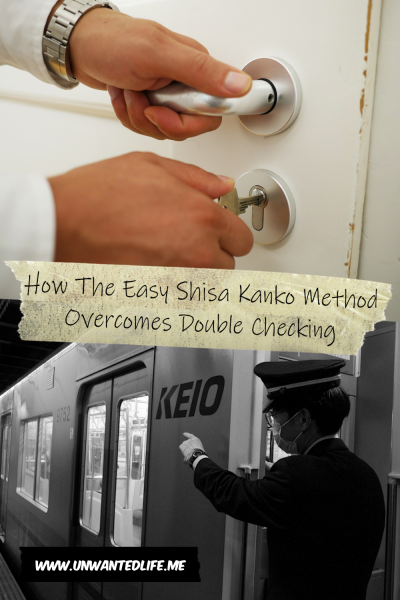
Shisa Kanko, or ‘pointing and calling’, is a Japanese safety technique famously used by railway workers to reduce errors. It works by engaging multiple senses: sight, speech, and physical movement to move a task from “autopilot” into conscious awareness. It requires railway workers to call out and point at the place or object simultaneously whenever an operation is being performed (Kim, Kho, Tan, and Lai, 2024).
This sequence of actions, as the Shisa Kanko is being performed, focuses attention on the exact task at hand. This ensures things are done at a high standard and counters complicantcy of repetitive tasks (Itsuki, 2026).
Checking OCD, OCD-Like Traits, And Shisa Kanko
Obsessive-compulsive disorder (OCD) can come in subtypes, like checking-OCD, and people can also have OCD-like traits (Shah, 2026). With checking behaviours and checking-OCD, the checking behaviour can vary from person to person, and is often based on the fear that drives the checking behaviour (Cognitive Behavioral Therapy Los Angeles, n.d.).
What’s interesting is that there doesn’t appear to be a consensors on whether these checking behaviours are caused by deficits in memory or by poor memory confidence (Radomsky, Gilchrist, and Dussault, 2006).
Part of the reason people might doubt their memory is because of the intrusive thoughts checking behaviours and checking-OCD come packaged with (Shah, 2026). Thus, to combat these intrusive thoughts and alleviate the stress they cause, checking behaviours develop or are reinforced.
This may cause people with checking behaviours and checking-OCD to be preoccupied at social gatherings or at work, worrying about whether they locked their front door, or if they left the oven on (Cognitive Behavioral Therapy Los Angeles, n.d.).
The main issue with checking behaviours is that the more we do it, the less we trust our memories. Even though we remember what happened correctly, how we feel about those facts changes, leading to us second-guessing ourselves. Doubt then grows. This was the key finding found in Radomsky, Gilchrist, and Dussault’s (2006) study.
In short, memory isn’t the issue; checking behaviours (which is meant to be the cure for the person doing it) creates the growth of doubt instead.
This is also supported by Radomsky, Rachman, and Hammond (2001), who found that the level of perceived responsibility had a huge impact on our confidence in our memory when it comes to OCD. We may not worry about whether we closed the lid on our toothpaste, because the stakes are low. But may experience extreme anxiety about whether we locked the door. To the point, we may have to return home just to check.
Applying Shisa Kanko To OCD-Like Checking Behaviours
When Shisa Kanko is applied to ease OCD-like traits and checking behaviours, it acts as a cognitive anchor to provide certainty and mental “closure”. But to use it effectively, we must perform three distinct actions simultaneously for a specific task.
- Point: Physically point our index finger at the object (e.g., the hob, the front door lock, or a plug).
- Look: Ensure our eyes are fixed on exactly what we are pointing at.
- Call: State the action/status out loud. It must be an audible, clear declaration.
For example: Pointing at the iron, and while looking at the iron, we’ll say aloud, “Iron is unplugged, safe”.
For those who struggle with the “did I or didn’t I?” loop, the brain often fails to register the memory of a routine task because it was done mindlessly. Or, we’ve come to distrust our memories because of the checking behaviours, as the checking behaviour causes us to doubt our memory, not the other way around (Radomsky, Gilchrist, and Dussault, 2006). Fortunately, Shisa Kanko will create a “sticky” memory.
The physical act of pointing, looking, and the sound of our own voice act as a “save button” for the brain. When the doubt creeps in later (“Did I lock the door?”), we can recall the specific moment we pointed and spoke the action/status aloud.
However, to avoid the same trap that repeated checking caused, the doubt about our memories, we have to apply the ‘one and done’ rule. Therefore, we use the Shisa Kanko technique once, firmly. If the urge to check again arises, acknowledge that the “pointing and calling” has already been recorded.
To make this extra sticky as a memory, add tactile feedback to the method. So, as we’re pointing at the object, briefly touch it with our finger tip while calling out, “Stove is cold, checked”. This adds an extra layer of sensory proof to our memory.
One of the reasons this process can be effective is that it’s an unusual behaviour to engage in, and novel (or awkward, depending on how we look at it), which helps things become a sticky memory, as it grabs our attention.
Tips For Using Shisa Kanko
Don’t be shy
The “Calling” part is the most vital for memory confidence. Without it, we’re not using the Shisa Kanko technique. So if we’re feeling shy, even a whisper is more effective than silence.
Visual aids
It can be useful to place a small sticker (like a bright dot) on “trouble” items to remind ourselves to perform Shisa Kanko. This will work as a self-nudge to engage with the technique.
Be specific
Being specific is key. So don’t rely on the old favour of just saying “Done”, say “Front door is double-locked, clear”. Specificity builds stronger memory confidence.
Other Wellbeing Uses For Shisa Kanko
Combating mindlessness
Shisa Kanko can be used for things other than checking behaviours. It’s possible to use it for small healthy habits. For example, we could try saying “Water bottle is full” while pointing at the bottle to help us reinforce our intention to hydrate.
Reducing brain fog
When we feel overwhelmed, we can use this technique to help ground ourselves in the present. Just point at three things we see: “Blue chair, seen. Green plant, seen. Window, seen”.
Task transition
I’m all for helping drive a wedge between work and our personal life, so when finishing work, we could point at our laptop: “Work is finished, switching off”. This creates a psychological boundary between our professional and personal lives.
Summary
Shisa Kanko has the potential to be a great tool to help overcome some OCD behaviours and checking behaviours. Not only is it a simple technique to use, but it can also help us return our faith in our memories. The fact that it can help avoid the mistakes that come from complacency is a bonus.
As always, leave your feedback in the comments section below. Also, please share your experiences with Shisa Kanko, checking habits, and OCD in the comments section below as well. Don’t forget, if you want to stay up-to-date with my blog, you can sign up for my newsletter below. Alternatively, click the red bell icon in the bottom right corner to get push notifications for new articles.
Lastly, if you’d like to support my blog, please find the PayPal and Ko-fi donation payment options below. Until next time, Unwanted Life readers.
References
Cognitive Behavioral Therapy Los Angeles (n.d.). Cognitive Behavioral Therapy for Checking OCD. Cognitive Behavioral Therapy Los Angeles. Retrieved from https://cogbtherapy.com/checking-ocd-treatment-los-angeles.
Itsuki, N. (2026, February 9). Pointing and calling: Japan’s railway safety technique. Nippon.com. Retrieved from https://www.nippon.com/en/japan-topics/g02575.
Kim, A. R. J., Kho, B., Tan, S., & Lai, W. H. (2024). Assessing the acceptability of shisa kanko for improving medication safety using the theoretical framework of acceptability at Sarawak General Hospital. Journal of Health Management, 21(2), 37-46. Retrieved from https://www.researchgate.net/profile/Alex-Kim-43/publication/384103514_ASSESSING_THE_ACCEPTABILITY_OF_SHISA_KANKO_FOR_IMPROVING_MEDICATION_SAFETY_USING_THE_THEORETICAL_FRAMEWORK_OF_ACCEPTABILITY_AT_SARAWAK_GENERAL_HOSPITAL/links/66ea9859596a6638d7315477/ASSESSING-THE-ACCEPTABILITY-OF-SHISA-KANKO-FOR-IMPROVING-MEDICATION-SAFETY-USING-THE-THEORETICAL-FRAMEWORK-OF-ACCEPTABILITY-AT-SARAWAK-GENERAL-HOSPITAL.pdf.
Radomsky, A. S., Rachman, S., & Hammond, D. (2001). Memory bias, confidence and responsibility in compulsive checking. Behaviour Research and Therapy, 39(7), 813-822. Retrieved from https://davidhammond.ca/wp-content/uploads/2014/12/2001-Memory-Compulsive-Checking-Radmomsky-et-al.pdf.
Radomsky, A. S., Gilchrist, P. T., & Dussault, D. (2006). Repeated checking really does cause memory distrust. Behaviour Research and Therapy, 44(2), 305-316. Retrieved from https://spectrum.library.concordia.ca/id/eprint/977643/1/Repeated_checking_really_does_cause_memory_distrust.pdf.
Shah, Y. (2026, March 19). Checking OCD: symptoms, causes, and treatment. NOCD. Retrieved from https://www.treatmyocd.com/blog/checking-ocd-symptoms-and-treatment.
This is the first time I heard of Shisa Kanko. This practice sounds interesting. The Japanese always offers good practice. Thank you for this new knowledge.
They’re quite the fountain of knowledge