Today’s article came from my experience with the energy exchange in depression. I wanted to understand how these were linked and if other people have experienced this. The result of that curiosity is this article. I hope you find it interesting.
The Energy Exchange In Depression: Social Vampire
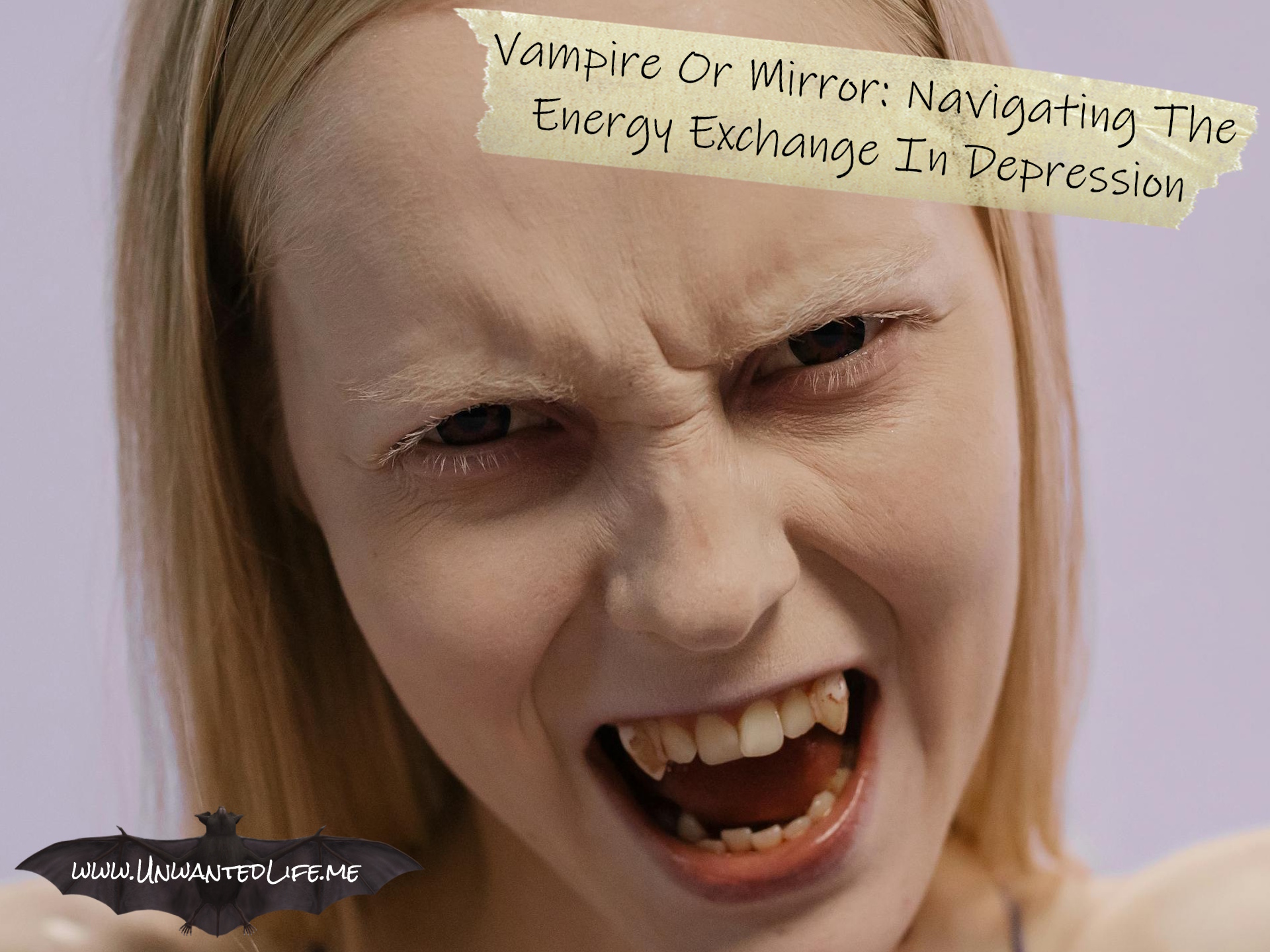
The term social vampire, also known as the energy vampire, describes someone who, intentionally or unintentionally, leaves those around them feeling emotionally exhausted or drained after an interaction. My mum is a prime example of such a person.
Unlike what we might expect for a typical introvert, which is a need for recharging after any socialising, and thus feels drained by a social interaction. A social vampire specifically saps our energy through their behaviour and the lopsided nature of the relationship. This is because they suck up all the attention in a conversation, and are often able to because they come across as charming and charismatic (DiGiullo, 2018).
Because of how a social vampire can monopolise our interactions with them, it’s not surprising that it can take a toll on the relationships they have with other people and their wellbeing (Dray, 2023). Having someone in our lives that leave us drained with every interaction is going to make us less eager to socialise with them.
It’s also worth noting that people can develop social vampirism because they learn that behaviour from their parent(s), and thus, could be unaware of its negative effects on others (DiGiullo, 2018).
How Depression Mimics “Vampiric” Traits
While a classic social vampire is associated with personality traits like narcissism, depression can create a similar draining effect on others, but through different psychological mechanisms. In these cases, the person isn’t feeding on our energy out of malice or selfishness, but rather out of a desperate, survival-based need for emotional regulation they cannot provide for themselves.
So someone with depression who’s exhibiting social vampire tendencies is unlikely to lie or blame others when things go wrong, like a classic narcissistic social vampire (DiGiullo, 2018). But because of their depression, they may forget to ask how we’re doing, instead focusing on talking about their situation, which can be frustrating for others (Dray, 2023). This is quite unintentional social vampirism.
When we’re experiencing depression, we can fall foul of cognitive tunnelling. This is where our attention gets narrowed to specific elements, causing us to overlook others (Pooladvand and Hasanzadeh, 2023). Thus, a person suffering from depression can be in so much pain that they literally cannot look past their own internal crisis.
Then there’s the reassurance-seeking behaviours of some of those with depression. According to Joiner, Metalsky, Katz, and Beach (1999), such a person will seek this assurance from others to alleviate their doubts about their self-worth and whether others care about them.
However, this assurance rarely works as it instead filters through their maladaptive core belief, turning that act of reassurance into something else, such as pity or obligation. This causes a dilemma of both needing that reassurance and not being able to believe it when they get it.
Consequently, they can become stuck in a cycle of constantly needing and demanding validation. All because their low self-worth leads to an ’empty bucket’ syndrome; no matter how much love is poured in, the person’s depression “leaks” it out, leaving them needing more.
There’s also learned helplessness. I’m not a fan of this term, especially as most of the work was done on animals in a laboratory setting in the 70s. But, this is when a depressed person loses hope about there being a way out of what’s making them depressed (Nuvvula, 2016). Thus, they stop looking for solutions and just want to moan about it instead. This can then lead to social vampire traits through the energy exchange in depression.
Another thing that may happen is the development of emotional dependency. This is when a depressed person might cling to someone and make them feel responsible for their mood. It makes sense when you put it in context. If someone’s internal world is a void, latching onto a stable person to feel a sense of safety or existence makes sense.
The “Trauma Dumping” Vs. “Vampirism” Distinction
So what’s the difference between true social vampirism and someone struggling with a depressive episode? It comes down to intent and reciprocity.
Intent
A depressed person usually feels deep guilt or shame about being a burden. Whereas a true social vampire often feels entitled to the energy of other people. This is the main factor in the energy exchange in depression; we’re not doing it because we want to, and often we don’t know we’re doing it.
Reciprocity
When a depressed person begins to recover, they usually return to being supportive and engage in give-and-take friendships. A social vampire, however, is a fixed behaviour, regardless of their mood.
Empathic Mirror, Social Catalyst, And A Radiant Presence
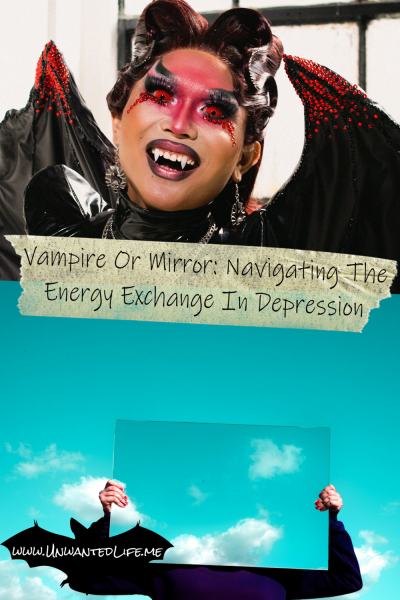
If the social vampire is someone who leaves the room feeling heavy and everyone else feeling hollow, the opposite is often described as a social catalyst, empathy mirror, empathy echo, or a radiant presence. Although we likely don’t use these words in our everyday language.
For these people, they still feed off the energy in a room, but they do so in a way that creates a virtuous cycle rather than a drain. In psychology and social dynamics, this is often referred to as relational energy. This means they create positive feelings as a direct result of an interaction with others. So instead of draining the energy from others, such a person reflects or radiates fuel for more energy to grow.
As a result, it can often feel like we’re resonating with such a person, as this empathy improves connectedness. This is also something films use to get is to empathise with the story and characters (Praszkier, 2016).
This works because the energy transfer is a symbiotic exchange, rather than an energy robbery. Such a person isn’t just taking; they are amplifying. If you give them a spark of an idea, they get excited, which makes us more excited. The “feed” is mutual.
Such a person can also cause the hype person effect, because they thrive on seeing others succeed. They “feed” on the positive vibes of a celebration or a win, but their presence actually makes the celebration feel bigger and better for everyone else.
Therefore, a key difference between a radiant presence and a social vampire is active listening. Instead of waiting for their turn to talk like a social vampire would, they “feed” on the details we give them to ask better questions. They allow us to feel heard, and they will feel engaged. It’s a win-win.
The Energy Exchange In Depression: A Person With Depression
High-functioning depression, or smiling depression as it’s often called, is where someone masks their internal struggle by becoming a source of light for others. When someone has depression but acts as a social catalyst or a radiant presence, they are often engaging in a complex psychological trade-off. They “feed” off the positive energy they generate because it provides a temporary, vital distraction from their own internal darkness. Something I know far too well.
The dynamic usually works like this. For someone with depression, their own internal battery is faulty for whatever reason and won’t hold a charge. To feel normal, or in my case, feel alive, they rely on external stimulation.
They often create a high-energy, positive environment because being the “life of the party” allows them to inhabit a character that isn’t depressed. In some unhealthy versions of this, they’ll also use substances to enhance and achieve the same effect.
For the healthy approach to this, the result is they don’t drain others because they’re usually the most supportive, funny, or engaged person in the room. Often, they are desperately trying to “catch” the joy they are creating for others, but for some, they can fully enjoy the moment of creating a positive space for others. It can feel great to be a giver like this, as it can counter our sense of worthlessness.
People who’ve struggled with depression and low mental health for a while can become very good at becoming aware of the moods of others. Thus, they can develop a drive to support others and to create a more fun environment when the conditions are right. All because we don’t want others to suffer like we are.
However, this can sometimes come at a cost, because the sense of joy can disappear once they leave that space. Once, after a night out, I walked through the door of my home, and I instantly went from having a great night with friends to a speedy decline into despair, and I tried to take my own life.
A person who experiences this change in mood is referred to as a depressed catalyst, which is the unhealthy version of a social catalyst, an empathy mirror, and a radiant presence. That’s because the energy we get is borrowed, and we have to pay that back. Thus, without the friends there, the mask drops.
The Energy Exchange In Depression: Protecting Our Relationships
Compassionate detachment
We can support someone without taking on their depression as our own. Use phrases like, “I can see you’re having a really tough time, and I’m here for you, but I only have 20 minutes to chat today”.
Diversifying support
Relying on one person to be our entire support system is a heavy weight for anyone to carry. Thus, try to steer ourselves or other people to obtaining a GP for a referral to talking therapies, to Mind, or to using services like Samaritans (116 123), which helps spread that emotional load. This will help with managing our energy exchange in depression.
Check-in rule
If we’re worried about being a social vampiric try a simple five-minute rule: Spend the first five minutes of a call asking about the other person and listening before moving into our own feelings. While we do this, give our full attention through the use of active listening, and this can help make our energy exchange in depression healthier.
How To Support A Radiant Friend With Depression
If we think someone might be “feeding” on social energy to mask their depression, then there are a few things we can do to support them with their smiling depression.
Validate them
Try to validate the side of them without their mask, the quiet version of themselves. Let them know we enjoy their company even when they aren’t “on” or being the entertainer.
Check-in
After spending time with them, where they’ve had the chance to feed and reflect the energy into the room, send a text a few hours afterwards to see how they’re feeling after that social high. Too often, we can feel like we’re only wanted or thought about while we’re radiating positive energy.
Low-stakes hangouts
It can be useful to offer low-stakes hangouts so it’s not just about being the life of the party, with a potential crash for them afterwards. Instead, activities that don’t require a performance, where they’d otherwise be wearing their mask, like watching a film, can do wonders for their self-worth.
The Energy Exchange In Depression: How To Protect Our Energy
Since we can’t always cut social vampires out of our lives, because they’re family or a work colleague, we have to resort to managing the flow of our energy instead.
The ‘grey rock’ method
Simply put, we become as boring as a grey rock. Give short, non-committal answers, or even become unresponsive. Our use of body language can also help with this, such as not giving them eye contact. If we don’t provide “food” (reaction/emotion), they’ll eventually look elsewhere (Fletcher, 2022).
Set time limits
Often, social vampires or someone displaying vampiric tendencies aren’t looking for solutions. So set a time limit for how long we can talk, and make sure we stick to it.
We’ve not their fixer
Because social vampires, and often those with vampiric tendencies, aren’t looking for solutions, once we stop trying to solve their problems, interactions with that person become less draining for us.
Summary
Although it might feel like a depressed person is a social vampire, in reality, it’s not the case. This is because such a person lacks the intent. After all, it comes from a place of suffering. But at the same time, a depressed person might not show vampiric traits either; they may instead be an empathy mirror. This is often why it can be hard to understand that friend who always seems happy around others, because that smile hides their depression, as they reflect and amplify the energy of those they’re around. Classic smile depression.
For a while, I thought I was a social vampire because my depression meant I could barely function without social ineractiong stopping me for spirial into despair. But now I know that’s not the case, I’m very much an empathy mirror. For me, I wasn’t feeding on others’ energy selfishly; I was radiating it back. I go out of my way to make those around me feel good, because I know what it’s like to feel utterly worthless, even in my deepest depressive states. This is my energy exchange in depression.
As always, leave your feedback in the comments section below. Also, please share your experiences with the energy exchange in depression in the comments section below as well. Don’t forget, if you want to stay up-to-date with my blog, you can sign up for my newsletter below. Alternatively, click the red bell icon in the bottom right corner to get push notifications for new articles.
Lastly, if you’d like to support my blog, please find the PayPal and Ko-fi donation payment options below. Until next time, Unwanted Life readers.
References
DiGiullo, S. (2018). How to spot (and deal with) an energy vampire. NBC News. Retrieved from https://static1.squarespace.com/static/5c706d5865a7072069cb09f8/t/5ef79e9fdfbc365ada97e4d6/1593286303829/Aug2.18_EnergyVampire.pdf and https://www.nbcnews.com/better/health/how-spot-deal-energy-vampire-ncna896251.
Dray, K. (2023, June 29). Psychology of friendship: the rise of the social vampire. Stylist. Retrieved from https://www.stylist.co.uk/relationships/social-vampire-friendship-psychology/560762.
Fletcher, J. (2022, December 1). What is the Grey Rock method and is it effective?. Psych Central. Retrieved from https://psychcentral.com/health/grey-rock-method.
Joiner, T. E., Metalsky, G. I., Katz, J., & Beach, S. R. (1999). Depression and excessive reassurance-seeking. Psychological Inquiry, 10(3), 269-278. Retrieved from https://www.researchgate.net/profile/Gerald-Metalsky/publication/245140730_Depression_and_Excessive_Reassurance-Seeking_This_is_the_actual_article_The_website_would_not_allow_me_to_upload_the_correct_pdf_for_the_full-text_article_because_it_already_had_a_pdf_the_wrong_one_of/links/0deec51d6da830d643000000/Depression-and-Excessive-Reassurance-Seeking-This-is-the-actual-article-The-website-would-not-allow-me-to-upload-the-correct-pdf-for-the-full-text-article-because-it-already-had-a-pdf-the-wrong-one-of.pdf.
Nuvvula, S. (2016). Learned helplessness. Contemporary Clinical Dentistry, 7(4), 426-427. Retrieved from https://journals.lww.com/cocd/fulltext/2016/07040/learned_helplessness.2.aspx.
Pooladvand, S., & Hasanzadeh, S. (2023). Impacts of stress on workers’ risk-taking behaviors: Cognitive tunneling and impaired selective attention. Journal of Construction Engineering and Management, 149(8), 04023060. Retrieved from https://www.researchgate.net/profile/Shiva-Pooladvand/publication/372812823_Impacts_of_Stress_on_Workers%27_Risk-Taking_Behaviors_Cognitive_Tunneling_and_Impaired_Selective_Attention/links/65caf15a34bbff5ba70c2f0e/Impacts-of-Stress-on-Workers-Risk-Taking-Behaviors-Cognitive-Tunneling-and-Impaired-Selective-Attention.pdf.
Praszkier, R. (2016). Empathy, mirror neurons and SYNC. Mind & Society, 15(1), 1-25. Retrieved from https://link.springer.com/content/pdf/10.1007/s11299-014-0160-x.pdf.
I encounter a lot of social vampires during my younger days. That’s why I choose to be a lonewolf now. It’s more calm for me. I only mix around with people who makes me feel good. Btw, most social vampires I’ve known are not narcissistic people. They are extremely friendly social butterflies. But they don’t have sincerity in them, and try to manipulate others by acting innocent. Some are even nosy and love forcing me to answer questions that is too personal and don’t want to answer. Geez… it was depressing!
Thank you for sharing your experience
This article is so insightful! Thanks for explaining the difference between being depressed and being a social vampire. It really made me reflect on whether I might be one or even both.
But have you considered if you might be a mirror instead?