
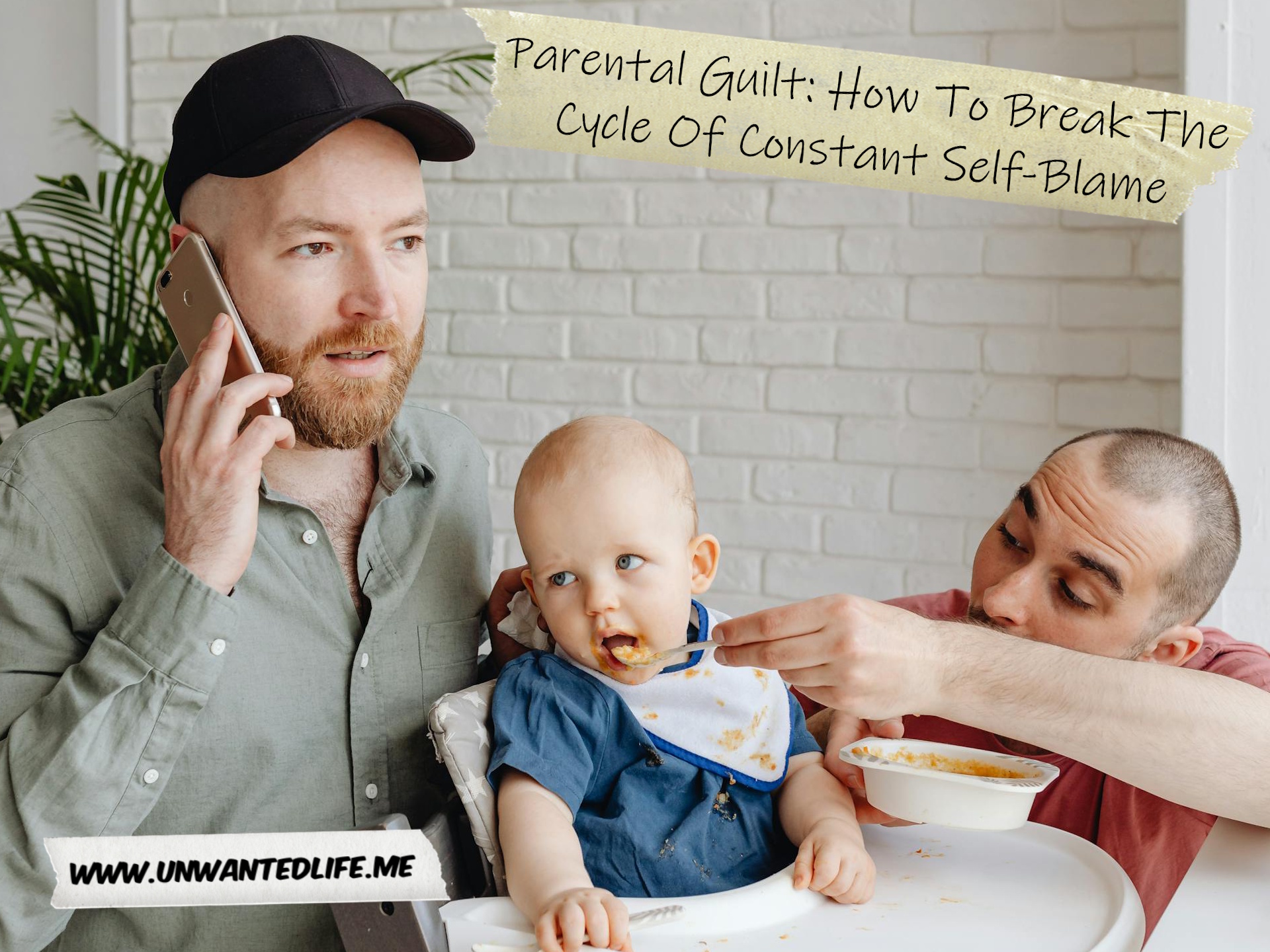
Life as a parent has never been an easy one, but it feels like it’s becoming harder, not easier, to be a parent because of the state of the world. There are a lot of expectations to be the perfect parent, and it’s this impossible standard I want to explore in today’s article on parental guilt.
Disclosure: This article contains links to my Unwanted Life Shop. Read my full disclosure here.
What Is Parental Guilt
Let’s start with the basics first. Guilt is an emotion resulting from a negative judgment we form about ourselves, where we believe we may have violated a distinct moral or engaged in some form of social transgression, resulting in us feeling discomfort (Haslam, Filus, and Finch, 2020).
Parental guilt is an incredibly common, albeit exhausting, companion on the journey of raising children. It often stems from the gap between the “ideal” parent we imagine and the reality of being a human being with limited time, energy, and patience.
Hindsight can be the worst for a parent. Worrying whether we could have done something differently, been a better parent, or been a super parent, and whether we’re already damaged our child(red) too much (Kouremetis, 2017).
Parental Guilt: Why ‘Good’ Parents Often Feel The Worst
Parental guilt can start because of things that aren’t really within our control or because we’ve made a mistake, which we all do. So we may have to break a promise or could have embarrassed our child(ren) in front of their friends and peers (Li, Ng, and Chiu, 2024).
Maternal guilt is the most common form of parental guilt because of the continuing struggle with gender roles. We still live in societies where gender roles and gender sterotypes means there’s a significant amount of pressure for mothers, but not fathers, to prioritise and sacrifice for their family over their work (Aarntzen, Derks, Van Steenbergen, and Van Der Lippe, 2023) and personal time.
Then there’s working parent parental guilt, where long working hours and being too tired after work can affect our relationships with our child(ren). But often there’s little control over that situation. There’s also the more extreme version of this, where parents are in the military, which also disproportionally affects mothers. Parents, especially navy parents, are often required to be absent from their child(ren) for very long periods of time periodically (Tucker and Kelley, 2009).
The expectations of parents and people in general are too high, given how difficult life is to navigate. in the 1950s-1970s. A family in most Western countries could afford to buy a home, a car, and pay their bills with money to spare on a single income. Nowadays, two incomes don’t even come close to that same standard of living. The world unfairly punished us all for women having control over their own lives and working.
However, the result of this is that we’re still left with the same parental expectations of those days, with the message that people, especially women, can have it all. If we’re in the top 1%, then sure, but for the rest of us, that’s not the case. One of the reasons the birth rate is falling in the Western world is because of the high cost of living involved in bringing up children, meaning having a family is often seen as not economically viable (Pettinger, 2025).
If only knowing that would help with the parental guilt that people feel. Somehow, we’re stuck with the idea of being the perfect parent while often juggling impossible situations for that to ever be more than a dream. Instead, parents are left with their preoccupation with self-criticism, concerns over mistakes, and doubts about their own behaviours (Lin, Szczygieł, Hansotte, Roskam, and Mikolajczak, 2023). The more we care about our child(red), the worst that can be.
Challenging Parental Guilt
Managing parental guilt isn’t about becoming a perfect parent, because there’s no such thing; it’s about recalibrating our expectations and practising self-compassion.
Reframe the “good parent” narrative
Guilt, such as parental guilt, usually shows up because we care deeply. If we didn’t care about our children’s wellbeing, we wouldn’t feel guilty about living up to this idealistic version of a parent. Therefore, try using that as a reminder of our commitment rather than a measurement of our failure.
The 70% rule
The idea of giving 110% is frankly a ludicrous thing to say. Even aiming for 100% excellence leads to burnout. The ideal is to aim for “good enough”. The 70% rules also applies to everything in life.
There’s a reason we don’t run things at their maximum level all the time, because that’s how things break. A sports car can’t sustain its maximum speed at all times, not unless you have an entire mechanics team on standby at all times to fix the problems that develop from keeping it at such a high speed.
There’s also growing evidence that suggests that children actually benefit from seeing parents navigate mistakes, as it teaches them resilience and empathy.
There’s nothing wrong with making mistakes. We all make them. It’s how we respond to those mistakes that matters, and our child(ren) will learn that from observing us as parents.
Focus on presence, not perfection
Five minutes of focused, phone-free connection often outweighs two hours of “being in the room” while feeling distracted or guilty.
Talking to your children
It may seem weird to do, but we’re often far harsher on ourselves than we are on other people, and children are often honest to a fault. So if we feel like we’re not doing enough for our child(ren) in some way, ask them.
Create a list
One of the quickest ways to understand how much we do as parents is to list what we do for our children, and then list what our partner does for the children as well. Just to see how this is split. We can then reflect on that and the potential differences. While reflecting, also think about the obstacles that are in the way of being the impossible ideal parent.
The “win” list
An alternative list that can be just as effective is to create a win list. At the end of the day, list three things that went well. For example, “They ate their veg” or “We laughed at a joke”.
Thought challenge
Try some simple reframing. Ask ourselves, if our friend or partner were doing everything we’re doing, would we think our friend or partner wasn’t doing enough?
Identify the “guilt triggers”
Not all guilt is created equal. Therefore, it can be helpful to distinguish between productive guilt (losing our temper and needing to apologise) and unproductive guilt (we had to work late or took a gym break). Parents are allowed to have breaks.
The fact-check
When guilt hits, ask ourselves, “Am I actually doing something wrong, or am I just breaking an unrealistic rule I made for myself?”.
The apology strategy
If we mess up, which we will do a lot (e.g., shouting), don’t spiral. Apologise to our child(ren). It models accountability and repairs the bond instantly.
Practise radical self-care
It sounds like a cliché, but clichés are clichés for a reason. We can’t pour from an empty cup. If our energy levels are depleted, our patience thins, which leads to outbursts or “checked-out” moments that cause guilt. Self-care is important for all of us. It’s not something that should be stopped for the sake of trying to be the perfect parent.
Release the martyrdom
Parent or not, we need to prioritise our own rest and hobbies. This isn’t “taking away” from our child(ren); it is “restoring” the person who looks after them. It also sets a good role model for the next generation of parents, should our child(ren) have children.
Challenge the “shoulds”
Should statements are one of, if not the worst, form of cognitive bias. Replace “should” statements with a little bit of reframing magic. For example, “I should be doing more educational play” with “I am providing a safe, loving environment where they can explore”.
Lower the bar
There’s nothing wrong with lowering the bar of unrealistic expectations. On high-stress days, make peace with “survival mode”. Cereal for dinner, leftovers for breakfast, and extra screen time are perfectly fine occasionally.
Furthermore, recognise that much of our guilt might be an external social pressure rather than a reflection of our actual parenting.
Counterbalance worksheet
Although it’s important to challenge parental guilt, so we’re not unfairly beating ourselves up for not living up to an impossible expectation of what a parent is. Because being kind to ourselves is important in this demanding world, for some of us, that might not be enough.
It can also be useful to take an objective look at the situation, to truly test if we’re doing a good job as a parent, and if not, work on the areas that could be improved.
To try this approach out, you can purchase my counterbalance mini-workbook over on my store by clicking here.
Challenge gender roles and gender stereotypes
Unfortunately, even though things have improved over the last few decades, in the majority of cases, it still falls to the mother to perform the childcare and household tasks at home (Aarntzen, Derks, Van Steenbergen, and Van Der Lippe, 2023).
This is supported by Collins (2021), who talks about how the US is the worst for this when compared to other Western countries. Further adding that such caregiving is even devalued compared to being the breadwinner.
As Aarntzen, Derks, Van Steenbergen, and Van Der Lippe (2023) highlighted, gender stereotypes and gender roles play a huge role in the parental guilt we all feel. Let’s undo this bias. If you’re the person who gave birth to the children, would we think differently if we were the other parent in the situation? For the sake of clarity, if we were the mother of the child(ren), would we think differently if we were the father in this situation, regarding not living up to the expectations? If so, it’s worth reflecting on that.
Summary
Parental guilt can be difficult to live with, as we want the best for our child(ren) (well, most of us do at least). But where that guilt comes from is important. Have we actually done something wrong, or not done something we should have? Or are we chewing ourselves out for not living up to an impossible standard, the standard of being a perfect parent in an imperfect world?
It’s not just parental guilt that’s harming us as a society. We can feel guilty because we’re “not doing enough” for our work, partner, etc., as well. This type of guilt should also be challenged. We all need to be kinder to ourselves and cut ourselves some slack.
As always, leave your feedback in the comments section below. Also, please share your experiences with parental guilt in the comments section below as well. Don’t forget, if you want to stay up-to-date with my blog, you can sign up for my newsletter below. Alternatively, click the red bell icon in the bottom right corner to get push notifications for new articles.
Lastly, if you’d like to support my blog, please find the PayPal and Ko-fi donation payment options below. Until next time, Unwanted Life readers.
References
Aarntzen, L., Derks, B., Van Steenbergen, E., & Van Der Lippe, T. (2023). When work–family guilt becomes a women’s issue: Internalized gender stereotypes predict high guilt in working mothers but low guilt in working fathers. British Journal of Social Psychology, 62(1), 12-29. Retrieved from https://bpspsychub.onlinelibrary.wiley.com/doi/pdfdirect/10.1111/bjso.12575.
Collins, C. (2021). Is maternal guilt a cross-national experience?. Qualitative Sociology, 44(1), 1-29. Retrieved from https://doi.org/10.1007/s11133-020-09451-2 and https://drive.google.com/file/d/15S4gXmTQra3Ezd_gIObkehdU_lpbbuZ8/view.
Haslam, D., Filus, A., & Finch, J. (2020). The Guilt about Parenting Scale (GAPS): Development and initial validation of a self-report measure of parenting guilt, and the relationship between parenting guilt and work and family variables. Journal of Child and Family Studies, 29(3), 880-894. Retrieved from https://www.academia.edu/122337124/The_Guilt_about_Parenting_Scale_GAPS_Development_and_Initial_Validation_of_a_Self_Report_Measure_of_Parenting_Guilt_and_the_Relationship_between_Parenting_Guilt_and_Work_and_Family_Variables.
Kouremetis, D. (2017, February 17). Do you continue to beat yourself up over less-than-stellar parenting skills? Psychology Today. Retrieved from https://www.psychologytoday.com/gb/blog/the-unedited-offspring/201702/the-gift-keeps-giving-coping-parental-guilt.
Lin, G. X., Szczygieł, D., Hansotte, L., Roskam, I., & Mikolajczak, M. (2023). Aiming to be perfect parents increases the risk of parental burnout, but emotional competence mitigates it. Current Psychology, 42(2), 1362-1370. Retrieved from https://orbi.umons.ac.be/bitstream/20.500.12907/43004/1/Lin-2021-Aiming-to-be-perfect-parents-increa.pdf.
Li, W., Ng, F. F. Y., & Chiu, C. D. (2024). When parents are at fault: Development and validation of the parental guilt and shame proneness scale. Journal of Personality Assessment, 106(5), 595-608. Retrieved from https://www.tandfonline.com/doi/pdf/10.1080/00223891.2024.2311208.
Pettinger, T. (2025, December 13). Impact of falling birth rates. Economics Help. Retrieved from https://www.economicshelp.org/blog/166908/development/impact-of-falling-birth-rates.
Tucker, M. M., & Kelley, M. L. (2009). Social support and life stress as related to the psychological distress of single enlisted Navy mothers. Military Psychology, 21(sup2), S82-S97. Retrieved from https://www.researchgate.net/profile/Michelle-Kelley-5/publication/240237409_Navy_Mothers_Experiencing_and_Not_Experiencing_Deployment_Reasons_for_Staying_in_or_Leaving_the_Military/links/564c09fd08ae3374e5ddf5f0/Navy-Mothers-Experiencing-and-Not-Experiencing-Deployment-Reasons-for-Staying-in-or-Leaving-the-Military.pdf.
Being parents is never easy. This is how my parents must have felt while raising me. My parents aren’t perfect. But they are awesome people. And they gave me more than they can afford. I’m forever grateful. Alhamdulillah.
It certainly is a tough. Thanks for commenting
Very good post. Thank you for sharing this.
Thanks for commenting