
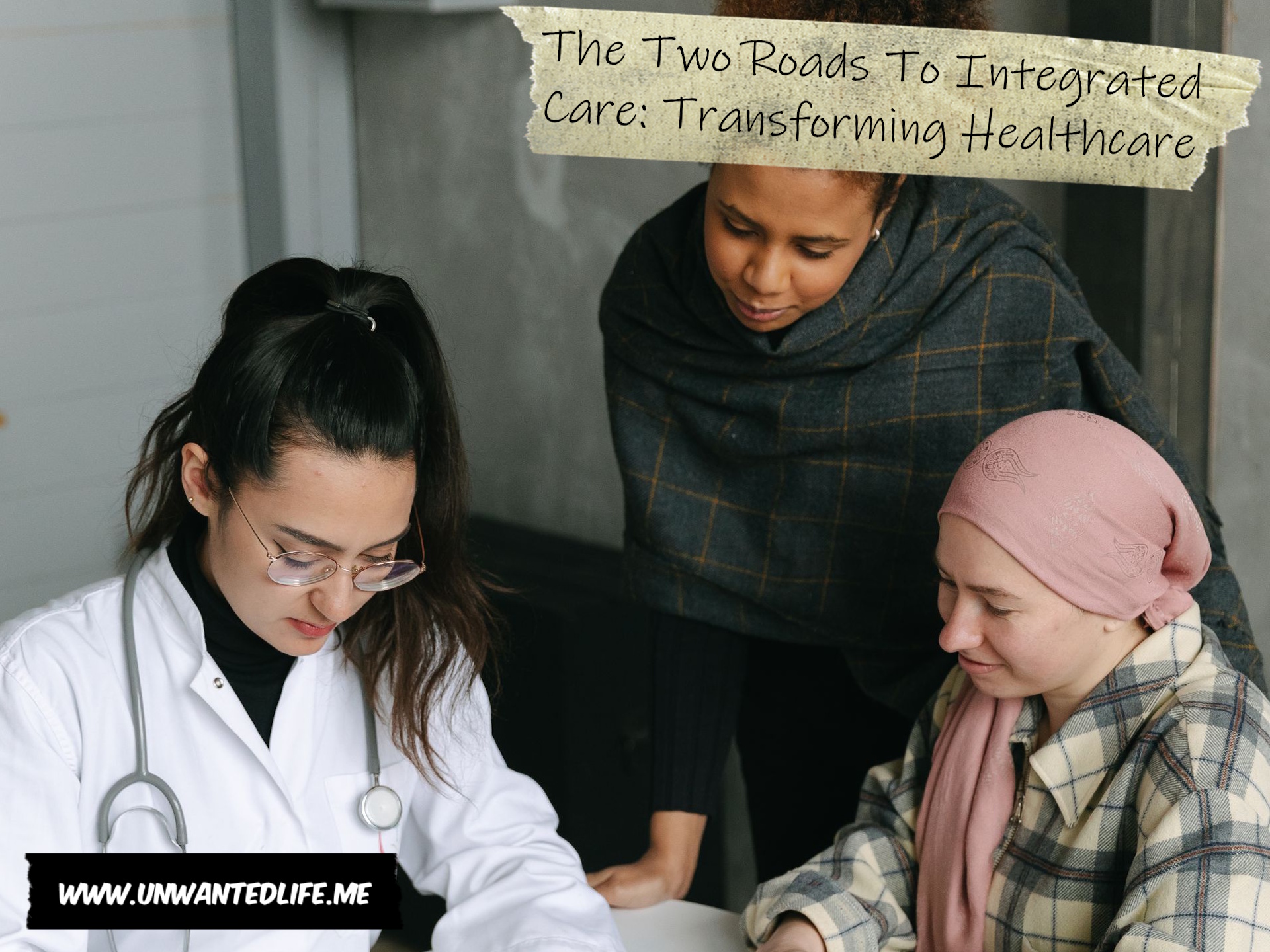
Integrated care is the holy grail of healthcare systems, yet many countries have yet to develop this model for various reasons. Until they catch up, we have to create our own integrated care. In this article, we’ll explore how integrated care could and is reshaping the future of health and mental health treatment and improving recovery outcomes for all of us. I’ll also discuss how we can create our own integrated care while we wait for the world to catch up.
Disclosure: This article contains links to my Unwanted Life Shop. Read my full disclosure here.
What Is Integrated Care
There is a push within mental healthcare to shift away from treating conditions in isolation and toward a more coordinated approach that focuses on each person’s overall wellbeing. I’ve been lucky enough to experience some of the first attempts at this in the UK, although this has come under the term integrated medicine.
This is because I have several health and mental health issues, with a cause of one set of symptoms that no one seems to be able to explain. Unfortunately, I’m not the only one to have both mental health and health issues. Many people experience this, which makes having coordinated care increasingly important for better outcomes.
According to the World Health Organization or WHO (2025), mental health conditions affect one in every seven people globally. In England, 20.2% (one in five) adults experience a common mental health condition, such as depression or anxiety. But that’s just common conditions. As more people require support, the need for accessible, coordinated, and person-centred mental healthcare continues to grow.
Integrated care brings together healthcare professionals from different disciplines to address both mental and physical health needs. This collaborative model will improve communication, reduce gaps in treatment, and support more personalised care. Something I’ve often complained about regarding the NHS.
My exercise in tolerance, I speculate, is a combination of health and mental health issues, but I’ve yet to see someone who can address both sides of this possibility. It’s been more than 16 years of investigations into this issue, and still no answers.
Even within therapy for my eating disorder issues, the treatments are too rigid to support those who don’t fit a specific expression of their eating disorder. Personalised care through integrated care would help with both of these.
Why Integrated Care Delivers Better Patient Outcomes
As I’ve already stated, coordinated care allows healthcare professionals to address mental and physical health needs through a shared treatment plan. This approach improves communication, reduces treatment gaps, and supports earlier intervention when symptoms first appear. We’ll also benefit from better follow-up and more personalised care across different healthcare settings.
Support for this view on integrated care and its benefits comes from McHugh et al. (2024). They performed a systematic review and meta-analysis of studies that assessed clinical or health service use outcomes of integrated care published between 2001 and 2023. Their result shows that integrated mental healthcare produced significantly greater reductions in depressive symptoms than usual care.
Beyond reducing symptoms, the study showed that integrated care improved participants’ ability to function in daily life. The review also found stronger patient engagement throughout the treatment process. These findings highlight how coordinated care can improve both treatment outcomes and the overall patient experience.
Integrated Care Is Whole-Person Care
Long-term physical health issues often co-occur alongside mental health issues such as anxiety, depression, and other behavioural disorders. In order to provide the best support for people with comorbid conditions, effective care requires healthcare professionals to consider both aspects of a patient’s health instead of treating them separately.
Delivering this type of care needs strong teamwork among physicians, nurses, therapists, social workers, and other healthcare professionals. Something that isn’t always forthcoming.
For example, with the NHS, our hospital records and our GP records aren’t connected. I’ve been seen by several hospitals at the same time so that I can see different specialists, and none of them shares their findings via a shared database, let alone through a shared care plan.
I’ve often been the go-between between these hospitals and my GP, because nothing is automatically shared with my GP either. It all comes down to a letter being generated and eventually passed on to the other aspects of my care. Not efficient at all.
Furthermore, it’s also nice not to have to keep repeating ourselves as we go from one hospital to another, or just between seeing a specialist and seeing our GPs. The number of times I’ve had to retell my health history and the one aspect of it that no one seems to understand is tiring in and of itself. I’ve wasted so much time doing this over the last 16 years.
As our needs become more complex in an ageing world, multidisciplinary training is becoming increasingly valuable. Advanced courses like dual FNP/PMHNP programs can help aspiring nurses to build expertise in both physical health and psychiatric mental health.
How Collaborative Care Reduces Gaps In Mental Health Treatment
I, like many people, seek help for mental health concerns through primary care before consulting a mental health specialist. It’s pretty standard to talk to our GP first in the UK, and either be given an antidepressant or for them to make a referral to the mental health service. In the US and other parts of the world, that may be different. Especially with how weird medical insurance is in the US.
However, once that referral has been made, our GPs likely won’t hear anything again about our mental health journey until we’re discharged from the mental health service, even though it’s all part of the NHS.
A study by Isaacs and Mitchell (2024) found that, in Australia at least, 87% of people visited their GP each year. Of that percentage, 71% involved discussions related to their mental health concerns. As part of their conclusions, much like the UK with the NHS, they state that integrated care would require a whole system change. This is because the area where the study took place in Australia also has fragmented mental health services.
An example of this from my life is how my local hospital has a mental health service and an eating disorder service on the same grounds, but they don’t share patient information. I was seeing both services at the same time for the same issue.
This lack of collaborative care can be a huge hindrance. Integrated care through true collaboration, on the other hand, would help address these challenges by connecting primary care providers with mental health professionals to deliver more comprehensive and continuous patient support. It would be nice to see our NHS, which is just so disjointed even though it’s all part of the same body, function as a single body.
The Role Of Technology In Supporting Integrated Mental Healthcare
Digital health tools are making mental health and health care more accessible, connected, and responsive to individual needs. Teletherapy, electronic health records, and mental health apps help providers coordinate treatment and maintain consistent communication.
These technologies also improve follow-up by allowing patients to access support between scheduled appointments. Yet, this hasn’t led to better integrated care in the UK. For the UK, that often comes down to a lack of funding.
Even though teletherapy has helped many people attend therapy more than ever, with Deb (2026) reporting that 86% of therapy clients believe teletherapy is more effective than traditional in-person sessions. Yet, other aspects of technological integration haven’t even caught up to allow a single shared medical record within the NHS as a whole.
We embrace the convenience and comfort of technology, such as using teletherapy (Foundation Fighting Blindness, 2026), but not in other technological ways. Embracing digital solutions will aid in strengthening integrated care by improving collaboration, patient engagement, and continuity of treatment.
Challenges To Implementing Integrated Care Models
Building integrated care requires healthcare organisations like the NHS to align clinical workflows, technology, and communication across multiple disciplines. This should already be happening. Yet, many providers are still using fragmented health records, facing workforce shortages, and a lack of healthcare professionals with overlapping knowledge.
I can only imagine how much of an issue this is in the US, given that different hospitals and doctors work for different private entities and with different health insurance providers.
Benjamin Miller, PsyD, an adjunct professor at Stanford University School of Medicine, in an article by Huddleston (2026), stated that the issue when it comes to integrated care comes down to one thing: the lack of quality healthcare infrastructure. In my experience, that means there’s a lack of interest in investing money in high-quality healthcare infrastructure.
Expanding integrated care will require stronger infrastructure, training, and better workforce support. In places like the US, it will also likely need some sort of payment models that encourage collaboration between medical and mental health providers, and insurance companies.
DIY Integrated Care In The UK
As things currently stand, we can’t wait for a more integrated healthcare model to be rolled out; we have to fill that void ourselves. Healthcare systems around the world are slowly moving towards integrated care behind the scenes (some more than others), but we don’t have to sit around and wait for the bureaucracy to catch up. Nor is it advisable to wait when it comes to our wellbeing.
On an individual level, getting integrated care means actively taking control of the space where our physical and mental health collide, forcing the system to communicate. It takes a bit of effort and strategy, but the results could mean we get the treatment we need sooner. The following tips will hopefully help all of us to build a cohesive, whole-person care approach for ourselves that we can tailor to our situations.
Self-referral
Not many people are aware of this, but in the UK, there are many options for self-referral to some, but not all, services. Because of this lack of awareness, many people assume we have to convince a GP to take us seriously just to get a referral.
In reality, we can often bypass this entirely. The most common self-referral service in the UK is NHS Talking Therapies. In a lot of areas of the UK, we can also self-refer to musculoskeletal services for joint issues.
Social prescribing
A lot of healthcare and GP services have started to integrate social prescribing services. To find out if our GP practice is one such service, all we need to do is ask if they have a social prescribing worker. These are professionals integrated into primary care whose entire job is to connect our mental and physical health with community support, exercise schemes, or social groups to tackle the root causes of distress.
There are also social prescribing organisations that can be accessed. This can help us gain more control over our health issues.

Force the communication loop
One of the biggest flaws in healthcare is that physical health teams and mental health teams rarely talk to each other. Or teams in the same hospital, for some reason. So we have to become the bridge. If we see a private therapist or a specific mental health professional, ask them to write a brief, formal summary of our treatment, goals, and progress.
Recently, I’ve made a subject access request for X-rays and other aspects of my health data, just so I can share it with my other specialists to speed things up.
Take this data (printout or digital file) to our GP surgery and explicitly request that the admin team upload it to our permanent NHS electronic record or our primary healthcare professional’s database. As a therapist myself, I’m happy to provide session summaries for each of our sessions, and if given consent by my client, to share more detailed case notes with other people involved in their care.
Choices
Within NHS England, there’s a lesser-known right that we have, and that’s the NHS Right to Choose. This allows us the right to choose a different NHS body to provide our care, helping us to avoid long local NHS wait times (ADHD UK, n.d.). Sometimes this is built into the referral system, which means we might get offered other local options, but it can also be countrywide upon request.
I’ve signposted a few people with dizziness disorders I’ve met through my blog to the specialist dizziness clinic I went to in London for this very reason. Many local services don’t have the specialist knowledge that can result in a correct diagnosis or in changes in quality of life.
Personal health budget (PHB)
If we have long-term complex mental health needs or are eligible for certain types of continuing NHS care, then we have the legal right to ask for a personal health budget. This means we can get NHS money allocated to fund a personalised care and support plan. This means that instead of the NHS choosing our treatment, we work with a professional to co-create a personalised care plan that fits our needs, rather than the cookie-cutter model the NHS uses.
We can use this budget to choose alternative therapies, specific equipment, or lifestyle support that bridges the gap between our physical and emotional needs. Furthermore, several people can pool their personal health budgets to create wellbeing groups. For more information on what the personal health budget can be used for, what it can’t be used for, and how to apply, click here.
Self-advocacy
I can’t express enough how important it is to be our own advocate when it comes to healthcare. If we still find ourselves not being listened to, then in the UK, we can raise a complaint with the Patient Advice and Liaison Service (PALS). A process I’ve had to go through many, many times. There are also advocacy services that can support us with our complaints as well.
DIY Integrated Care In The US
Find a “collaborative care” primary care clinic
From what I can understand about parts of the US medical system, there is an integrated care system in place called the Psychiatric Collaborative Care Model (CoCM) and other models (Reist et al., 2022). I don’t know if this is countrywide or changes state by state, but apparently, you don’t have to wait for a psychiatrist referral to get mental health support.
Under the CoCM framework, major insurance providers actively reimburse primary care doctors to manage mental health in-house. Check with your insurance provider if that’s an option.
Use the “insurance code” strategy to force communication
If you see an independent therapist and a separate primary doctor, they operate in completely siloed systems. Much like in the UK. Because of HIPAA privacy laws, they cannot share information without explicit permission. Thus, you have to force them to coordinate. It appears that your primary care provider can actually bill your insurance for coordinating with your therapist.
You just need to tell your doctor you want them to manage your mental health treatment under CPT Billing Code 99484 (General Behavioural Health Integration; Behave Health, 2025). Again, I’d check with your insurance provider. It’s weird that Americans seem to have to know cheat codes to get integrated care. You must have to have a deep understanding of your health insurance just to get the right care.
It appears that there is also another step that needs to be followed: where you’ll need to sign a Release of Information (ROI) form at both your therapist’s office and your doctor’s office. Once that legal bridge is built, ask your therapist to send their clinical notes and treatment plan directly to your doctor’s administrative staff to add them to their medcatal reacords they have on you.
Know your insurance policy in and out
The more I learn about the American healthcare system, the more I realise that for once, knowing the terms and conditions is important. We may get away with just clicking ok for various terms and conditions for video games and websites, but when it comes to American healthcare, you need to know every single thing about your insurance policy. Not knowing is how they screw you over.
It very much sounds like that if you don’t ask for it, they won’t offer it, so they don’t have to pay for it.
Warm handoff
I don’t know if it’s just my mind, but that sounds a little naughty. Anyway, I discovered there’s such a thing as a ‘warm handoff’ within American healthcare, if you have the right insurance. Upon request, this is where you’ll be transferred between two service providers through a face-to-face, phone, or technology-assisted interaction (Taylor and Minkovitz, 2021).
So, if this was used to help you link up with a mental health provider, then you don’t have to worry about whether the referral was made or if they received it. Or if you’re really lucky, they’ll walk someone in from the mental health team right into the room with you and your doctor to join the consultation.
Mental Health Parity and Addiction Equity Act
Another thing I found out about is the Mental Health Parity and Addiction Equity Act (MHPAEA), which is a US federal law requiring insurance companies to treat mental health benefits equally to physical health benefits.
If they’ll cover diabetes medication, then they should cover mental health support and medication as well. There’s just so much to know in order to get what you’re paying for when it comes to the American healthcare model.
General DIY Integrated Care
Appointment checklist
Before we have an appointment, it can be useful to fill out a quick framework to ensure our doctor sees the whole picture rather than fragmented pieces:
- The Anchor: What is the primary physical or mental symptom driving our visit?
- The Ripple Effect: How does that primary symptom directly alter our mood, sleep, or physical capabilities?
- The Missing Link: What support or treatment are we currently missing that connects the two? For example, should I need a physical therapy plan that accounts for severe anxiety spikes, or if I needed talking therapy that understands my chronic illness or disability.
Change how we present symptoms
A lot of doctors are trained to treat the immediate symptom in front of them. If we go in complaining of stomach pain, they’ll look at our gut. If, like me, you go in complaining about sweating too much since starting on antidepressants, they’ll focus on the sweating, not the cause. Especially given that I have tried to move them past the sweating and onto overheating issues, which has been impossible so far.
In 0°C weather, I can still walk around feeling hot in a thin T-shirt and thin hoodie, while everyone else is dressed for the Arctic.
To get integrated care, we must present it as an unbroken chain when we can, the full range of cause and effect, what might make the symptoms worse, the role our mental health plays, etc. or that’ll be overlooked. And it’s really hard to get that focus broadened again.
For example, when my physical pain spikes to a 7/10, my anxiety causes panic attacks, which then make my muscles tense up and doubles the pain. I need us to treat both pieces of this loop together, not just one.
Symptom log
My partner and I talk about this a lot because memories aren’t as good as we need them to be. It can be to our advantage to track our symptoms before an appointment, ideally as soon as we notice something doesn’t seem right—both physical and mental health symptoms.
We can do this in a journal, a notebook, or an app like Bearable. A symptom log makes for a good journaling task, but there’s something to be said for the convenience of an app like Bearable. I used Bearable myself for quite a while to track my symptoms to help me get a better understanding, and I gave that data to my specialist at the time.
Ask the ‘whole person’ question
During our appointment. Explicitly ask our GP how our symptoms could be impacting our other issues, both health and mental health, so we address both. For example, my exercise intolerance can be really debilitating, but it’s worse when I try to exercise at the gym. But I still experience a less extreme version at home 99% of the time when exercising.
Thus, I speculated that the physical symptoms must trigger an anxiety response, causing the symptoms to worsen when in public. Therefore, a treatment plan that accounted for both would be ideal. This has yet to happen for me, though.
Bridge the communication gap
Post-appointment, never be afraid to follow up and chase up. If we see a private therapist or even an NHS therapist and an NHS GP, don’t assume they talk to each other. The same goes for healthcare around the world.
Most of it falls apart because of bad admin, so always chase and follow up to make sure the things that are meant to be happening are happening. The number of times I’ve found out the referral they said they’d make hadn’t been made is dumbfounding. If needed, don’t be afraid to make a complaint. After all, we’re our best advocate.
FAQs
What questions should I ask before choosing a mental healthcare provider?
Ask about the provider’s experience, treatment approach, communication style, and collaboration with other healthcare professionals. Also discuss appointment availability, telehealth options, and insurance coverage. Ask how your progress will be monitored to ensure the care plan meets your mental health needs.
Can integrated care reduce the need for multiple medical appointments?
Yes. Integrated care can reduce the need for multiple appointments by improving coordination between healthcare providers. Shared treatment plans and better communication streamline referrals, reduce duplicate assessments, and improve coordinated care. However, we may need to bridge that gap ourselves, depending on how our healthcare system works in our area.
What steps can patients take to become involved in their care?
Patients can become active partners by communicating openly, following treatment recommendations, and attending scheduled appointments. Asking questions, sharing concerns, and providing honest feedback about symptoms or progress also help healthcare providers adjust treatment plans to better meet individual needs.
We can track our own symptoms, get copies of our medical information, log complaints if needed, and we can make sure we know what we need to talk about in our appointments ahead of time. And in the US, it’s all about knowing your health insurance inside and out.
Key Statistics On Integrated Mental Healthcare
| People worldwide living with a mental disorder | Nearly 1 in 7 live with a mental health condition (WHO, 2025) |
| Therapy clients who believe teletherapy is more effective than in-person therapy | 86% (Deb, 2026) |
| People who visit a general practitioner each year | 87% (Isaacs and Mitchell, 2024) |
| GP visits involving psychological health concerns | 71% (Isaacs and Mitchell, 2024) |
Summary
Integrated care has the ability to reshape health and mental health treatment by bringing healthcare professionals together to deliver more coordinated and personalised support. Something that is often lacking, especially within the NHS. This collaborative approach would improve communication, reduce treatment gaps, create more accurate treatment plans, and address both physical and mental health needs.
If advances in technology are combined with multidisciplinary care, making integrated care more common, we, the people, will get more accessible and connected services. In fact, we should already be getting this.
The fact that it’s not is likely due to a lack of continued investment in workforce training, care coordination, and digital health solutions, which will further strengthen these models. Hell, in 2023, over two million NHS computers were still using Windows XP and Windows 7.
Ideally, by working together across specialities, healthcare providers would deliver more effective care and support better long-term outcomes for people and communities. Until then, we’ll just have to remember to DIY our integrated care needs.
As always, leave your feedback in the comments section below. Also, please share your experiences with integrated care in the comments section below as well. Don’t forget, if you want to stay up-to-date with my blog, you can sign up for my newsletter below. Alternatively, click the red bell icon in the bottom right corner to get push notifications for new articles.
Lastly, if you’d like to support my blog, please find the PayPal and Ko-fi donation payment options below. Until next time, Unwanted Life readers.
References
ADHD UK. (n.d.). Right to choose (NHS England). ADHD UK. Retrieved from https://adhduk.co.uk/right-to-choose/right-to-choose-learning-about-nhs-right-to-choose.
Behave Health. (2025, March 10). CPT Code 99484: BHI Billing Guide. Behave Health. Retrieved from https://behavehealth.com/blog/understanding-cpt-code-99484-a-comprehensive-guide-to-behavioral-health-integration-billing.
Deb, T. (2026, January 30). Technology in Mental Health Statistics By Disorders, Adoption, User Base, Counseling (2026). Market.us Media. Retrieved from https://media.market.us/technology-in-mental-health-statistics.
Foundation Fighting Blindness. (2026, Feb 10). The benefits of online therapy go beyond convenience. Foundation Fighting Blindness. Retrieved from https://www.fightingblindness.org/resources/the-benefits-of-online-therapy-go-beyond-convenience-756.
Huddleston, C. (2026, June 4). Managing the high cost of mental health care. Kiplinger. Retrieved from https://www.kiplinger.com/personal-finance/health-insurance/managing-the-high-cost-of-mental-health-care.
Isaacs, A. N., & Mitchell, E. K. L. (2024). Mental health integrated care models in primary care and factors that contribute to their effective implementation: a scoping review. International Journal of Mental Health Systems, 18(1), 5. Retrieved from https://doi.org/10.1186/s13033-024-00625-x and https://pmc.ncbi.nlm.nih.gov/articles/PMC10854062.
McHugh, C., Hu, N., Georgiou, G., Hodgins, M., Leung, S., Cadiri, M., Paul, N., Ryall, V., Rickwood, D., Eapen, V., Curtis, J., & Lingam, R. (2024). Integrated care models for youth mental health: A systematic review and meta-analysis. Australian & New Zealand Journal of Psychiatry. Retrieved from https://journals.sagepub.com/doi/10.1177/00048674241256759 and https://doi.org/10.1177/00048674241256759.
Reist, C., Petiwala, I., Latimer, J., Raffaelli, S. B., Chiang, M., Eisenberg, D., & Campbell, S. (2022). Collaborative mental health care: A narrative review. Medicine, 101(52), e32554. Retrieved from https://doi.org/10.1097/MD.0000000000032554 and https://pmc.ncbi.nlm.nih.gov/articles/PMC9803502.
Taylor, R. M., & Minkovitz, C. S. (2021). Warm Handoffs for Improving Client Receipt of Services: A Systematic Review. Maternal and Child Health Journal, 25(4), 528–541. Retrieved from https://doi.org/10.1007/s10995-020-03057-4 and https://pubmed.ncbi.nlm.nih.gov/33392929.
WHO. (2025, September 30). Mental disorders. WHO. Retrieved from https://www.who.int/news-room/fact-sheets/detail/mental-disorders.
The government in Malaysia is also implementing integrated care. I’m glad. And hope this will help us to become better everyday.
You’re so lucky. The UK is really far behind with this