
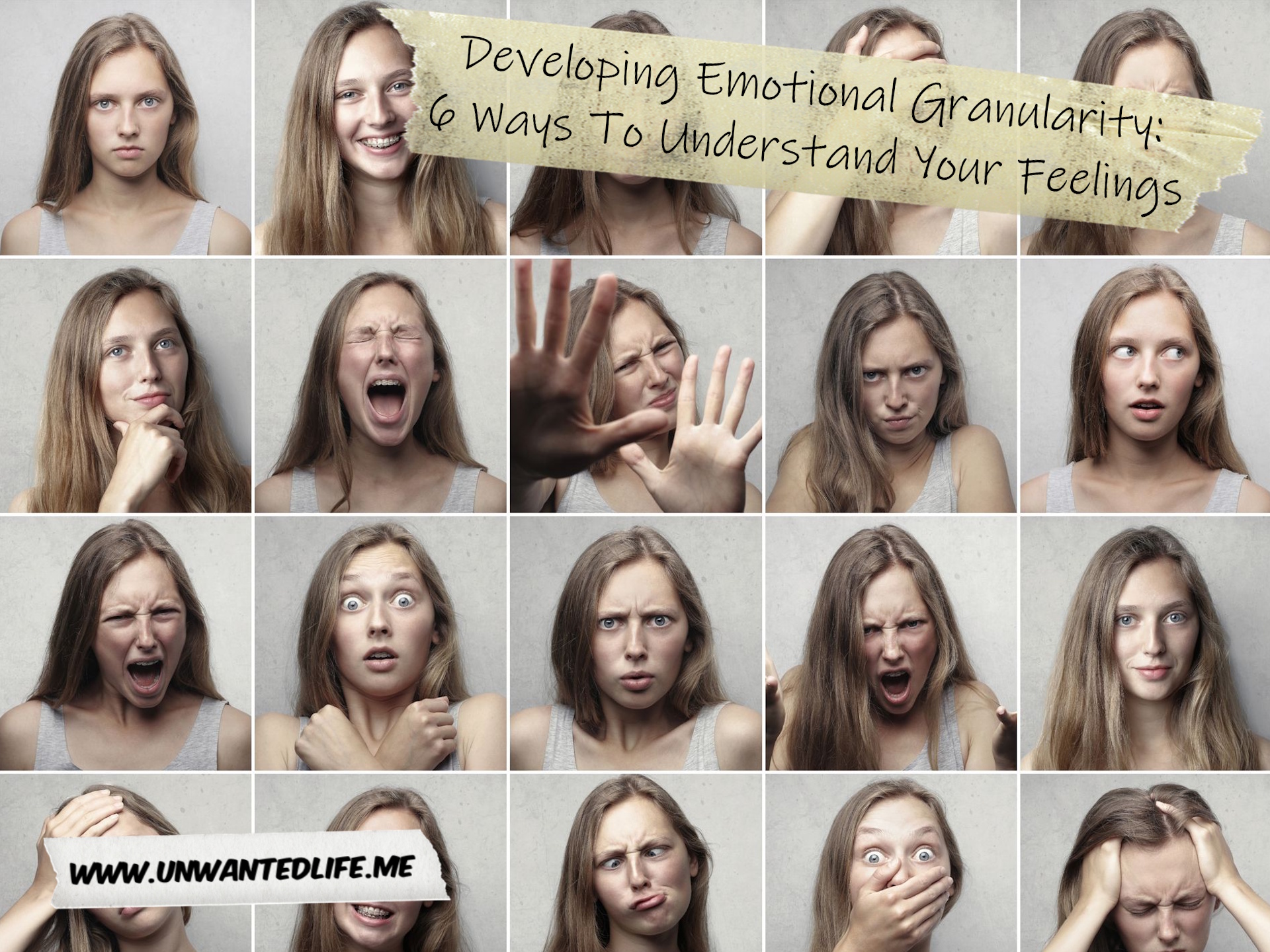
As someone with borderline personality disorder (BPD) and very blunted emotions, I’ve always found it hard to know what I’m feeling, as everything just feels “meh”. I seem to fall into the smiling depression category. Thus, I thought discussing emotional granularity might not only be useful to me, but the rest of you reading this article as well. Enjoy.
What Is Emotional Granularity
Emotional granularity, also known as emotion differentiation (Tierney, 2024), is the ability to perceive, differentiate, and precisely label one’s own emotional experiences. It’s an important skill that allows us to make fine-grained distinctions in our affective feelings (Wilson-Mendenhall and Dunne, 2021).
Think of it this way, if our car breaks down and we know the specific issue, we can get that fixed with minimal effort, whereas a vague notion of what the issue might be is going to take a lot longer to resolve. It’s the same with our emotions (Simply Psychology, 2026).
The reason knowing our true emotions is important is because emotional states can be perceived as the same when they have subtle but important differences (Simply Psychology, 2026). This differentiation allows us to better understand the causes of our emotions, and thus, helps facilitate contextually sensitive emotion regulation (Tan, Wachsmuth, and Tugade, 2022).
What we may see as anger, could in fact be a feeling of fear or loneliness (Wilson-Mendenhall and Dunne, 2021). If we only see us as being angry, then that limits our response to managing the situation and the emotion effectively.
But if we’re able to understand that anger is a secondary emotion to feeling scared or being lonely, then we can work on that root cause feeling by taking more specific actions (Simply Psychology, 2026).
A good example of this comes from Erbas, Gendron, and Fugate (2022). Imagine having a chat with someone from our social support network, like a friend or our partner, but at the end of it we feel bad, yet we’re not quite sure why. Now imagine that same interaction, but afterwards we feel guilty.
In the latter, we have a emotional label that’s very specific when compared to the former. With the specific emotion known, it gives us a clearer understanding of what we could do next, such as calling or messaging our loved one to apologise.
Not long ago I wrote about the differences between anxiety and stress, because they are easily confused for each other, because they overlap in a lot of areas. But there is a very important difference between these two feelings, and that difference will determine treatment and self-care approaches.
It’s not just about putting our feelings into words, which can also reduce our amygdala response (Simply Psychology, 2026). It’s about the ability to not only identify our emotions with precision and specificity, in a context-sensitive way, but to express them with that same precision and specificity in a context-sensitive way (Tierney, 2024).
This can also be useful in therapy. According to Erbas, Gendron, and Fugate (2022), research suggests that people with mental health conditions like BPD and major depressive disorder are likely to have low emotional granularity. But if such people learn to develop high emotional granularity then self-harming is less likely to occur. Furthermore, people with high emotional granularity are less likely to use maladaptive coping strategies or outcomes, like comfort eating, self medicating with substances, and using aggression.
Simply put, it suggests that people with low in granularity are unable to make the fine-grained distinctions in our emotional experiences (Wilson-Mendenhall and Dunne, 2021), leading to the adoption of unhealthy coping strategies or reactionary responses.
There is one important caution to remember with emotional granularity is that it’s not rumination. We’re not meant to be spending hours analysing are feelings to find the exact right emotion, as that’s associated with worse outcomes (Simply Psychology, 2026).
The Benefits Of High Emotional Granularity
Improved emotion regulation
According to Erbas, Gendron, and Fugate (2022), research has shown that high emotional granularity is linked with good emotional regulation, and that people with low emotional granularity are less able to regulate negative emotions.
This is supported by Tierney (2024), who states that when we can pinpoint exactly what we’re feeling, we’re better equipped to choose the appropriate strategies or responce in order to cope. Thus, is we recognise we’re feeling lonely, rather than just feeling sad, we can then pick a strategy like reaching out to someone, joining a friendship app, or joining a shared hobbies and interests group like meetup.com.
Reduced emotional reactivity
People with higher granularity are less likely to overreact, feel overwhelmed by stress, or resort to maladaptive coping strategies like problematic drinking and comfort eating. The act of labeling the feeling creates a cognitive “buffer”, allowing us to avoid simply reacting. Thus, the high our emotional granularity is, the less likely we are to respond aggressively to a perceived provocations (Simply Psychology, 2026).
Better decision-making
We’re an emotional species, so emotions will influence our decisions, often more than we realise. But when we understand the specific feelings at play, we can make choices that align with needs and values (Tierney, 2024). It also aids in good problem-solving.
Greater resilience
Granularity helps in reframing situations, making it easier to find positive takeaways or move forward constructively from difficult experiences. Because knowing the specific emotions involved helps with us picking more targeted responses or coping strategies, it makes emotional granularity an important tool in our resilience toolbox.
Better communication
Precise emotional language allows for clearer communication in relationships, helping others understand our needs and provide appropriate support. It also leads to deeper connections with the people in our social support network (Tierney, 2024).
It could be the difference between telling our partner to leave us alone because we’re angry, and telling our partner that we’re feeling overwhelmed because we’ve got too much on our plate. With the latter, they may be able to help us lighten that load.
Developing Emotional Granularity
Feelings wheel
The difference between high and low emotional granularity can lie in the breadth of our emotional vocabulary and conceptual understanding. Although Simply Psychology (2026) argues that it’s not about vocabulary memorisation, but rather practice in emotional discrimination. To help understand our feelings without vocabulary memorisation, feelings wheels can be used.
There are many images that can be found online of a feelings wheel that can be used to help us develop a deeper understanding of our specific feelings, but there’s also an interactive website that makes it far easier to understand. It can be found here: https://www.feelingswheel.com.
Is doesn’t matter which feelings wheel we use, they all follow the same principle. We start from the centre and pick the emotion we think we’re feeling, then we try to get more specific in the next section (middle layer) of the wheel by picking a emotion that’s connected to the first primary feeling we had. We can then do the same again with the outer layer.
Practice contextual labeling
It’s not just about being specific with our emotions, it’s also about the context in which we feel that way. Therefore, when we feel an emotion we should also note why and where we feel it (Simply Psychology, 2026). Try completing this sentence “I feel [specific emotion] because [specific reason]” (Tierney, 2024). For example, it’s not just saying I’m sad about today, but to say that I feel disappointed that I didn’t speak up in the meeting today.
Pause and reflect
When we notice an emotional response, take a short moment to ask ourselves, “What is this rather than….?” as this helps with discriminating between emotions (Simply Psychology, 2026). Remember, we can also have a mixture of feelings that may also be contradictory. For example, “What is this rather than me feeling sad?”.
Journal
There’s always time for a journaling task. Writing about our feelings in a journal can help us uncover the nuances and patterns within our emotions over time (Tierney, 2024), aiding in our ability to develop higher emotional granularity (Tierney, 2024).
Thus, writing about our emotions regularly, especially with mention of the triggers involved and the intensity, helps us build a deep understanding of our self and our emotions (Simply Psychology, 2026).
Mindfulness
Taking the time to engage in mindful and reflective practices that encourage non-judgmental observation of our inner states by simply observing and recording our feelings as they arise will help us to breakdown our feelings into their parts, granting deeper understanding (Simply Psychology, 2026).
Summary
As an emotional species, emotions play a role in everything we do. But often we over simplify those emotions, and that can be part of the problem with living as an emotional being. As humans, emotions are rarely simple, and we can even experience several different and often conflicting emotions at the same time. This is what makes emotional granularity important to our wellbeing.
Whether our emotional granularity is high or low will affect our quality of life. If it’s low, then we may live a life where we just respond and don’t really understand ourselves, meaning we’re not making the best choices in life. If it’s high, then we give ourselves the best chance to not let our emotions dictate everything, adding to our resilience.
That’s because the ability to understand the exact emotions we’re feeling in any given situation is a valuable tool for us to have. Making it fundamental to our quality of life.
As always, leave your feedback in the comments section below. Also, please share your experiences with emotional granularity in the comments section below. Don’t forget, if you want to stay up-to-date with my blog, you can sign up for my newsletter below. Alternatively, click the red bell icon in the bottom right corner to get push notifications for new articles.
Lastly, if you’d like to support my blog, please find the PayPal and Ko-fi donation payment options below. Until next time, Unwanted Life readers.
References
Erbas, Y., Gendron, M., & Fugate, J. M. B. (2022). Editorial: The role of emotional granularity in emotional regulation, mental disorders, and well-being. Frontiers in Psychology, 13, 1080713. Retrieved from https://doi.org/10.3389/fpsyg.2022.1080713 and https://pmc.ncbi.nlm.nih.gov/articles/PMC9714615.
Simply Psychology. (2026, August 25). Emotional granularity: Why naming it precisely changes what you can do. Simply Psychology. Retrieved from https://www.simplypsychology.com/articles/emotional-granularity-guide.
Tan, T. Y., Wachsmuth, L., & Tugade, M. M. (2022). Emotional nuance: Examining positive emotional granularity and well-being. Frontiers in Psychology, 13, 715966. Retrieved from https://www.frontiersin.org/journals/psychology/articles/10.3389/fpsyg.2022.715966/full.
Tierney, C. (2024, December 16). Discover emotional granularity: enhance your wellbeing. Cultivate Mental Health. Retrieved from https://cultivatemh.ca/blog/the-power-of-emotional-granularity.
Wilson-Mendenhall, C. D., & Dunne, J. D. (2021). Cultivating Emotional Granularity. Frontiers in Psychology, 12, 703658. Retrieved from https://pmc.ncbi.nlm.nih.gov/articles/PMC8751584 and https://doi.org/10.3389/fpsyg.2021.703658.