
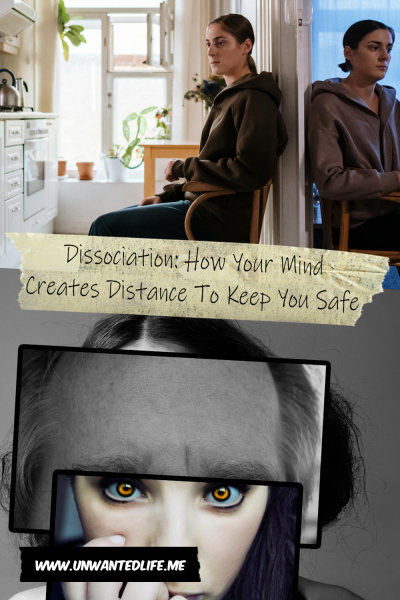
When I first started studying psychology, dissociation wasn’t really mentioned, but the now nonexistent multiple personality disorder was. This is now known as dissociative identity disorder (DID; NHS, 2025).
In this article, we’ll explore the concept of dissociation, its types, potential causes, and the impact it can have on our lives. By shedding light on this often-misunderstood topic, especially on how it’s changed over the years, this will help foster empathy and understanding for those who experience dissociation.
What Is Dissociation
Dissociation is a complex psychological phenomenon that involves a temporary detachment from one’s thoughts, emotions, memories, or even one’s sense of self. This is often regarded as a defence mechanism, where dissociation can serve as a way for us to cope with overwhelming stress, trauma, or distressing experiences.
However, we can all experience dissociation. The growing view on dissociation is that it comes in two flavours, pathological and “normal” (Moskowitz, 2004). Therefore, it’s important to note that occasional mild dissociation is relatively common and may not necessarily indicate a mental health concern.
Falling within what is considered “normal” (I hate that term in this context), there are the common dissociative experiences we can all experience, as I’ve said. Such as daydreaming and lapses in attention (Giesbrecht, Lynn, Lilienfeld, and Merckelbach, 2008). These are all associated with healthy psychological functioning.
Another form of healthy dissociation is how we can become absorbed in a book or film, but also in work or studying (Mind, n.d.), where we can enter a flow state. When this happens, we can lose awareness of our surroundings and even our own bodily drives, such as hunger. A similar state happens when driving a familiar route.
On the other side of the coin, there’s the pathological dissociation, which is frequent in mental health conditions such as borderline personality disorder (BPD), post-traumatic stress disorder (PTSD), and schizophrenia (Giesbrecht, Lynn, Lilienfeld, and Merckelbach, 2008). As well as dissociative identity disorder (DID), dissociative amnesia, and depersonalization/derealization disorder.
A study by Dalenberg et al. (2012) tested the trauma model and fantasy model of dissociation so they could understand this relationship. They found that there was a strong relationship that showed that trauma could cause dissociation, and that this dissociation remains related to trauma history. This is basically what PTSD is.
According to Loewenstein (2018), the vast majority of research has demonstrated the post-traumatic basis of dissociation in both the clinical and non-clinical populations.
This is further supported by Spitzer, Barnow, Freyberger, and Grabe (2006), who state that dissociation experiences are a diagnostic criterion of PTSD and BPD, but also acute stress disorder (ASD). They also note that it can be a feature of a wide variety of mental health conditions, such as schizophrenia, affective disorders, and obsessive-compulsive disorder (OCD). They also talk about its connection to trauma in general.
The Three Main Forms Of Dissociation
Depersonalisation-derealisation disorder
Depersonalisation involves a sense of detachment from oneself, so we might have feelings of being outside ourselves and observing our own body, actions, feelings, or thoughts (NHS, 2025). It may manifest as feeling robotic, disconnected, or as if we are living in a dream-like state.
Derealisation, on the other hand, is where we feel the world isn’t real, so we might experience a sense of detachment from our surroundings, where the external world appears unreal, hazy, or distorted. Thus, people might seem “lifeless”, or we might feel like we’re watching life through a foggy lens (NHS, 2025).
These two are grouped because it’s possible to experience both of these together. Where, it may last a few moments or come and go over many years.
Dissociative amnesia
Dissociative amnesia involves the inability to recall significant personal information, often related to traumatic or stressful events, which cannot be attributed to some form of brain damage (Kikuchi et al., 2010). Memory gaps may be selective, affecting specific periods or aspects of one’s life, and are not due to ordinary forgetfulness.
However, researchers such as Mangiulli, Otgaar, Jelicic, and Merckelbach (2022) have struggled to find evidence of this, and they suggest other factors might better explain this, such as ordinary forgetting, intentional fabrication, or gross exaggeration.
This is counter to the current NHS (2025) position, which states that these gaps in memory are far more severe than ordinary forgetfulness and are not the result of another medical condition. They can also cause a person to forget a talent or skill, which throws “It’s like riding a bike” out of the window.
Dissociative identity disorder (DID)
DID is characterised by the presence of two or more distinct identities or personality states within a single mind. These identities may have unique behaviours, memories, and ways of perceiving the world. But it can also cause a feeling of uncertainty about one’s identity and who one is (NHS, 2025).
The Impact Of Dissociation
Because dissociation often emerges as a response to trauma or overwhelming stress. Traumatic experiences, such as childhood abuse, neglect, or witnessing violence, can disrupt the development of a coherent sense of self and contribute to dissociative symptoms.
Other factors that may contribute to dissociation include severe accidents, natural disasters, or experiences of war, which can lead to the development of PTSD. Furthermore, dissociation can also occur as a result of certain medical conditions, substance abuse, or as a side effect of medications.
Living with dissociation can be challenging and impact various aspects of our lives. Persistent dissociation can lead to difficulties in concentration, memory, emotional regulation, and interpersonal relationships. It may also cause distress, confusion, and a sense of disconnection from oneself and others. People with dissociative disorders may experience disruptions in their daily functioning and struggle with identity confusion.
According to the NHS (2025), some people with a dissociative disorder can have seizures or find themslves wondering around in a confused state.
Thus, if you or someone you know is experiencing significant distress or impairment due to dissociation, it is crucial to seek professional help. Mental health professionals, such as a psychiatrist, can conduct a thorough evaluation, provide an accurate diagnosis, and offer appropriate treatment options.
Dissociation Toolkit
Because dissociation is the brain’s “emergency exit” from stress or trauma, managing dissociation is about gently signalling to our nervous system that we are safe in the present moment. This is what makes grounding really useful as part of a management plan.
Immediate sensory grounding
One of the often-used and talked-about grounding techniques is the 5-4-3-2-1 method, which I’ve also written about before in an article on grounding techniques. It also works well with anxiety disorders and as part of a mindfulness lifestyle.
When we feel ourselves “slipping away” or getting foggy, we use our senses to anchor ourselves. This forces our brain to switch from internal defence to external processing.
- Think of five things we can see.
- Think of four things we can touch.
- Think of three things we can hear.
- Think of two things we can smell. If there are no scents nearby, think of our favourite smells or sniff a nearby piece of fruit or coffee.
- Think of one thing we can taste – If there’s nothing to hand to help with this, try focusing on the lingering taste of our last meal or of something minty (such as when we cleaned our teeth).
Alternatively, carrying around a textured object that we can run our thumb or fingers across can be enough for some people to pull their attention back to the present.
Temperature shock technique
Strong physical sensations are very effective at “snapping” the brain back into the body. This is one of the reasons we have smelling salts for when someone is unconscious. We can also use the same strong scent approach to keep us grounded in our bodies in the present moment. This can be achieved by keeping a bottle of essential oils with us.
Keeping to the temperature shock aspect of this technique, holding an ice cube, dunking our hands in cold water, or splashing cold water on our face will shock us back into the present moment within our bodies (CALM, n.d.).
Understanding our “window of tolerance”
Dissociation typically occurs when we enter a hypoarousal state, such as the fight-or-flight type of situation. Managing it means learning how to stay within our “window of tolerance”, which is the zone where we can effectively manage our emotions (PTSD UK, n.d.).
To do this, it helps to identify triggers. This can be a simple journal exercise, where we try to pay attention to what happens right before we dissociate. Once we know our triggers, such as the trigger being a specific person, a loud noise, or a certain feeling in our body, we can work out how to better manage those triggers and the associated feelings.
This will hopefully allow us to expand the window of tolerance. To that end, it can be useful to develop a habit of using mindfulness and breathing exercises when we’re not dissociating as a way to build our capacity to handle stress. That way, we can break them out when our window of tolerance is being tested.
Body-based anchoring
Since dissociation involves a detachment from the body, physical movement can be an easy-to-do grounding technique to use at any time or anywhere. Below are three examples of this.
- Heel drops: Stand up and lift our heels off the floor, then drop them back down firmly onto the floor. Then focus on the feeling of the vibration travelling up our legs.
- The ‘weighted’ feel: Sit in a chair and push our feet as hard as we can into the ground. Notice the feeling of gravity and the weight of our body in the chair.
- Tapping: Gently tap our collarbones or the tops of our thighs. This rhythmic movement provides a predictable physical sensation to focus on.
Compassionate self-talk
Dissociation can be scary, which often creates and feeds anxiety, leading to deeper dissociation. So break the cycle by acknowledging the process without judgment, because we need to be kind to ourselves. This can be done by stating what’s happening, that “I’m dissociating right now. My brain is trying to protect me because it thinks I’m in danger, but I am actually safe”.
Another approach is called orienting statements. For this, all we need to do is state facts about our current reality, such as our name, where we are, the date, the time, what we’re wearing, etc. and add “I’m safe” at the end of it.
Long-term management
If dissociation is a regular occurrence, consider a professional path so we can help ourselves avoid unnecessary suffering. I prolonged my issues with psychosis by waiting 15 years before seeking help, prolonging my suffering. Approaches like trauma-informed therapies can be really useful for this, such as EMDR (eye movement desensitisation and reprocessing) or somatic experiencing.
Summary
As Mind (n.d.) stated, dissociation is one of the ways our minds may choose to cope when exposed to too much stress, such as during a traumatic event. It can also become a learned response to protect ourselves. But it can also be common variety lapses in attention and daydreaming. The latter is nothing to worry about, but if it’s at a problematic level, then there are options to help manage or overcome that.
As always, leave your feedback in the comments section below. Also, please share your experiences with dissociation in the comments section below as well. Don’t forget, if you want to stay up-to-date with my blog, you can sign up for my newsletter below. Alternatively, click the red bell icon in the bottom right corner to get push notifications for new articles.
Lastly, if you’d like to support my blog, please find the PayPal and Ko-fi donation payment options below. Until next time, Unwanted Life readers.
References
CALM. (n.d.). Temperature DBT Skill. CALM. Retrieved from https://www.thecalmzone.net/deal-with-it/temperature-dbt-skill.
Dalenberg, C. J., Brand, B. L., Gleaves, D. H., Dorahy, M. J., Loewenstein, R. J., Cardena, E., Frewen, P. A., Carlson, E. B., & Spiegel, D. (2012). Evaluation of the evidence for the trauma and fantasy models of dissociation. Psychological Bulletin, 138(3), 550. Retrieved from https://www.researchgate.net/profile/Bethany-Brand/publication/221695375_Evaluation_of_the_Evidence_for_the_Trauma_and_Fantasy_Models_of_Dissociation/links/0922b4f88d3be03381000000/Evaluation-of-the-Evidence-for-the-Trauma-and-Fantasy-Models-of-Dissociation.pdf.
Giesbrecht, T., Lynn, S. J., Lilienfeld, S. O., & Merckelbach, H. (2008). Cognitive processes in dissociation: an analysis of core theoretical assumptions. Psychological Bulletin, 134(5), 617. Retrieved from https://cris.maastrichtuniversity.nl/ws/portalfiles/portal/1447181/guid-e9da9b8d-96f0-4999-9d09-0f28f59c0cff-ASSET1.0.pdf.
Kikuchi, H., Fujii, T., Abe, N., Suzuki, M., Takagi, M., Mugikura, S., Takahashi, S., & Mori, E. (2010). Memory repression: brain mechanisms underlying dissociative amnesia. Journal of Cognitive Neuroscience, 22(3), 602-613. Retrieved from https://www.researchgate.net/profile/Shunji-Mugikura-2/publication/24215695_Memory_Repression_Brain_Mechanisms_underlying_Dissociative_Amnesia/links/54dde0900cf22a26721d1740/Memory-Repression-Brain-Mechanisms-underlying-Dissociative-Amnesia.pdf.
Loewenstein, R. J. (2018). Dissociation debates: Everything you know is wrong. Dialogues in Clinical Neuroscience, 20(3), 229-242. Retrieved from https://www.tandfonline.com/doi/pdf/10.31887/DCNS.2018.20.3/rloewenstein.
Mangiulli, I., Otgaar, H., Jelicic, M., & Merckelbach, H. (2022). A critical review of case studies on dissociative amnesia. Clinical Psychological Science, 10(2), 191-211. Retrieved from https://ricerca.uniba.it/bitstream/11586/414800/3/Mangiullietal_ACriticalReviewofDissociativeAmnesia_inpress_CPS.pdf.
Mind. (n.d.). Dissociation and dissociative disorders. Mind. Retrieved from https://www.mind.org.uk/information-support/types-of-mental-health-problems/dissociation-and-dissociative-disorders/about-dissociation.
Moskowitz, A. (2004). Dissociation and violence: A review of the literature. Trauma, Violence, & Abuse, 5(1), 21-46. Retrieved from https://www.academia.edu/18689604/Dissociation_and_Violence_A_Review_of_the_Literature and https://doi.org/10.1177/1524838003259321.
NHS. (2025, November 12). Dissociative disorders. NHS. Retrieved from https://www.nhs.uk/mental-health/conditions/dissociative-disorders.
PTSD UK. (n.d.). The Window of Tolerance and PTSD. PTSD UK. Retrieved from https://www.ptsduk.org/the-window-of-tolerance-and-ptsd.
Spitzer, C., Barnow, S., Freyberger, H. J., & Grabe, H. J. (2006). Recent developments in the theory of dissociation. World Psychiatry, 5(2), 82. Retrieved from https://pmc.ncbi.nlm.nih.gov/articles/PMC1525127/pdf/wpa050082.pdf.
I experienced dissociation back in 2020. I reminisced of my past too much during the lockdown. Yeah, it makes me scared socialise with people. But alhamdulillah, I’m now slowly going out of the sacred threshold. I realised that bad experience is for me to learned. Not to isolate myself. Thank you for sharing.
Thanks for sharing your experience
So is switching off from a certain situation the same as dissociation or is it completely different? Thanks
It can depend on the context, but yes